Body Acne Responds to Face Ingredients, Used Differently
Leave a benzoyl peroxide wash on for a few minutes, add an OTC retinoid and change out of sweaty gear fast. Deep, painful acne needs a dermatologist.
By Rachel Moreno · Published
8 sources · Our standards
Straight answer
Body acne is the same condition as facial acne: pores on the chest, back and shoulders clog with oil and dead skin, and bacteria and inflammation turn them into pimples. Sweat trapped under clothing, friction from straps and gear, hormones and family history all make it worse. Most mild to moderate body acne improves with a benzoyl peroxide wash left on for a few minutes, an over-the-counter retinoid, and some changes to how you work out and dress. Deep, painful breakouts need a dermatologist.
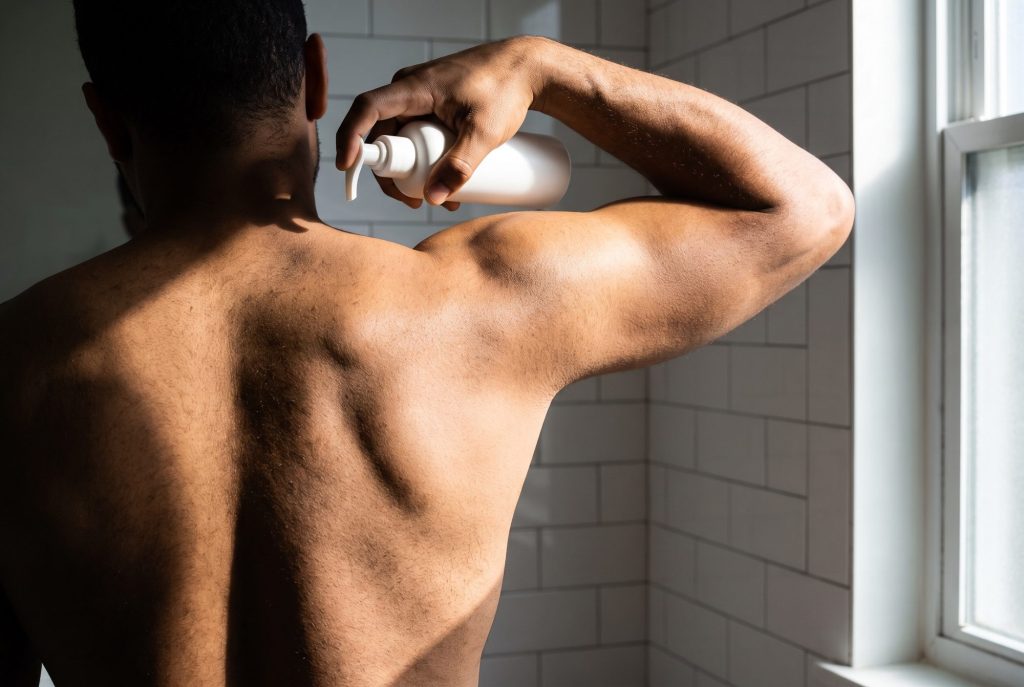
Breakouts below the neck tend to get less attention than facial acne, partly because it’s covered most of the day. But it’s common, and Cleveland Clinic notes that back acne is especially common in teenagers and young men (Cleveland Clinic). It also shows up in adults, often around workouts, new medications or hormonal shifts.
The good news is that the chest, back and shoulders respond to the same proven ingredients as the face. The tricky part is getting them onto skin you can’t easily see or reach, and keeping them there long enough to work.
Jump to
What causes body acne
Back acne develops when sweat, oil, dead skin cells and bacteria get trapped in pores, according to Cleveland Clinic, which lists these contributing factors (Cleveland Clinic):
- Friction: shirts, backpacks, bra straps, sports equipment and anything else that rubs sweaty skin.
- Trapped sweat: especially under tight or synthetic workout clothes worn for long stretches.
- Hormones: changes during puberty and pregnancy.
- Family history: acne runs in families.
- Some medications, including corticosteroids.
- Pore-clogging products: heavy body lotions, oils and some hair products.
- Stress.
Workout acne
The AAD explains that workouts can trigger breakouts through heavy sweating plus a buildup of oil, dirt and bacteria on the skin. It isn’t a separate disease, just ordinary acne made worse by exercise conditions (AAD). Shoulder pads, helmets, tight sports bras and backpacks add pressure and friction on top of the sweat.
Chest and shoulders
The same mechanism applies: anything that traps sweat or rubs, such as tight athletic tops, bra bands and bag straps, can aggravate breakouts on the chest and shoulders. The AAD advises avoiding anything that rubs against the back, including backpacks, and carrying a handheld bag instead (AAD).
The short list
- Acne on the back and chest is regular acne in a different location. The same ingredients work.
- Benzoyl peroxide works best on the back when left on the skin for two to five minutes before rinsing.
- Pairing benzoyl peroxide with an over-the-counter retinoid improves results.
- Showering and changing soon after workouts, and cutting friction from straps and gear, prevents many flares.
- Expect improvement in 6 to 8 weeks and clearer skin in 3 to 4 months.
The body acne routine dermatologists recommend
The AAD’s 2024 acne guidelines give their strongest recommendations to topical benzoyl peroxide and topical retinoids, alone or combined, with salicylic acid and azelaic acid among the conditionally recommended options (AAD). For the back and chest, the AAD’s practical advice looks like this (AAD):
1. A benzoyl peroxide wash, used the right way
Benzoyl peroxide kills acne-causing bacteria. The AAD recommends a benzoyl peroxide foaming wash used daily, and notes that it works best when left on the back for two to five minutes before rinsing. A 5.3% product is less likely to irritate, dry or peel the skin than stronger versions (AAD). Lather it on at the start of your shower, wash your hair and the rest of your body, then rinse it off last.
One practical warning: benzoyl peroxide bleaches fabric. Use white towels and sheets, and let the skin dry fully before putting on dark clothes (AAD).
2. An over-the-counter retinoid
Retinoids help unclog pores. The AAD recommends applying adapalene gel, a retinoid sold over the counter, once a day after showering or before bed, and notes that using it along with benzoyl peroxide improves results (AAD). Apply a thin layer to the whole breakout-prone area, not just individual spots; the AAD says spot-treating only visible blemishes is one of the habits that keeps acne going (AAD).
For hard-to-reach skin, a long-handled lotion applicator or a clean, flat sponge helps.
3. Gentle everything else
The AAD warns that scrubbing, harsh products, over-washing and over-drying all irritate skin and can lead to more breakouts (AAD). Skip loofahs and gritty scrubs on active acne, use a mild cleanser, and pat skin dry. For the moisturizer and sunscreen you use on your chest and back, look for “non-comedogenic” or “oil-free” on the label (AAD).
4. Give it time, and don’t keep switching
The AAD says to use an acne product for 6 to 8 weeks before judging it (AAD). For back acne specifically, it says you should start to see results in 6 to 8 weeks, with clearing in about 3 to 4 months (AAD).
Treatment options at a glance
| Option | What it does | How to use it on the body | Watch out for |
|---|---|---|---|
| Benzoyl peroxide wash | Kills acne-causing bacteria | Daily; leave on 2 to 5 minutes, then rinse | Bleaches fabric; dryness at higher strengths |
| OTC retinoid gel | Unclogs pores | Thin layer once daily over the whole area | Dryness and irritation at first |
| Salicylic acid | Helps clear pores | Body washes or pads, including after workouts | Over-drying if overused |
| Azelaic acid | Treats acne and can help fade dark marks | Thin layer on breakout areas | Irritation; stop if it burns |
| Prescription treatments | Stronger topical or oral options | Only with a clinician | Need medical supervision |
Workout and clothing habits that prevent flares
- Wear loose-fitting cotton or sweat-wicking clothes for workouts, and wash them after every use (AAD).
- Shower and change as soon as you can after exercising. If you can’t, the AAD suggests oil-free cleansing wipes or salicylic acid pads (AAD; AAD).
- Pat sweat away with a clean towel instead of rubbing (AAD).
- Wipe down shared gym equipment and don’t share gear such as helmets and pads (AAD).
- Swap a backpack for a handheld bag when your back is breaking out (AAD).
- Change sheets and towels regularly. Cleveland Clinic lists dirty linens among contributing factors (Cleveland Clinic).
Dark marks and scars after body acne
Breakouts on the back and chest often leave marks behind, and on medium and deep skin tones those flat dark spots can outlast the pimples by months. The AAD recommends treating acne and dark spots at the same time, starting treatment early, and avoiding scrubbing or popping, since more severe acne raises the risk of dark patches and keloids in darker skin (AAD). The AAD also cautions that chemical peels and lasers can cause lasting dark marks on darker skin unless performed by someone with expertise (AAD).
For the marks themselves, a 2022 systematic review found the best-quality evidence for retinoids, hydroxy acids and broad-spectrum sunscreen in treating post-inflammatory hyperpigmentation (Tan et al., 2022). That’s convenient: the retinoid you use for acne also works on the marks. The AAD says marks a few shades darker than your skin typically take 6 to 12 months to fade (AAD). Our guide to hyperpigmentation on legs covers the same process in more detail.
Popping and squeezing push bacteria deeper and raise the risk of scarring, according to the AAD (AAD). Cleveland Clinic adds that picking at lesions risks scars and infection (Cleveland Clinic).
When to see a dermatologist
The AAD says self-care can work for mild back acne (a few blemishes) and moderate acne (a mix of whiteheads, blackheads and pimples that isn’t painful or deep), but anyone with deep, painful acne on the back needs a dermatologist’s help (AAD).
Get it looked at if
- breakouts are deep, painful, or form hard lumps under the skin
- there’s no improvement after 6 to 8 weeks of consistent over-the-counter treatment
- acne is leaving scars or dark marks that bother you
- breakouts started after a new medication or with other signs of hormonal change
- bumps are crusted, oozing, warm or increasingly painful, which can suggest infection
- you’re not sure whether what you have is acne at all
A dermatologist can confirm the diagnosis and may prescribe stronger topical or oral treatments. The AAD notes that virtually every case of acne can be successfully treated with a dermatologist’s help (AAD).
For keeping body skin in good shape between flares, see our weekly body care routine.
Frequently asked questions
What causes body acne in adults?
The same process as teenage acne: clogged pores, oil, bacteria and inflammation. In adults, triggers include trapped sweat and friction from workouts, hormonal changes, family history, stress, some medications and pore-clogging products (Cleveland Clinic).
How do I get rid of back acne fast?
There’s no overnight fix. A daily benzoyl peroxide wash left on for two to five minutes plus an over-the-counter retinoid is the AAD’s go-to approach; expect results in 6 to 8 weeks and clearing in 3 to 4 months (AAD).
Does sweat cause breakouts on the back?
Sweat trapped on the skin, combined with oil, dirt and friction, can trigger breakouts (AAD). Showering and changing promptly after workouts helps.
Should I use body wash with salicylic acid or benzoyl peroxide?
Both are options. The AAD’s acne guidelines give a strong recommendation to benzoyl peroxide and a conditional one to salicylic acid (AAD). Many people use a benzoyl peroxide wash in the shower and salicylic acid pads when they can’t shower right after exercise (AAD).
Can body lotion cause back acne?
It can if it’s heavy or oily. The AAD recommends products labeled non-comedogenic or oil-free on acne-prone skin and lists cocoa butter and shea butter among oil-based ingredients that can clog pores (AAD).
Why do I get acne on my chest but not my face?
Chest skin has its own triggers: sweat trapped under tight tops and sports bras, friction from straps, and heavy body products. The treatment is the same as for back acne, applied to the chest (AAD).
About the author
Rachel Moreno writes Body Skin Insider's guides to crepey skin, discoloration, dry skin and the ingredients that help, with a focus on the skin below the chin. Each guide lists its sources and spells out when a spot or change should be seen by a dermatologist.
How we put this together
8 sources went into this guide, including the American Academy of Dermatology, Cleveland Clinic and peer-reviewed studies. Claims link straight to the source that backs them.
This guide doesn’t link to any product our publisher sells.
Sources
- American Academy of Dermatology. “Back acne: How to see clearer skin.” AAD. aad.org
- Cleveland Clinic. “Back Acne (‘Bacne’).” Cleveland Clinic. my.clevelandclinic.org
- American Academy of Dermatology. “Is your workout causing your acne?” AAD. aad.org
- American Academy of Dermatology. “10 skin care habits that can worsen acne.” AAD. aad.org
- American Academy of Dermatology. “10 tips for clearing acne in darker skin tones.” AAD. aad.org
- American Academy of Dermatology. “American Academy of Dermatology issues updated guidelines for the management of acne.” AAD News, 2024. aad.org
- American Academy of Dermatology. “How to fade dark spots in darker skin tones.” AAD. aad.org
- Tan MG, Kim WB, Jo CE, et al. “Topical treatment for postinflammatory hyperpigmentation: a systematic review.” Journal of Dermatological Treatment, 2022. pubmed.ncbi.nlm.nih.gov
General information, not medical advice. For a spot that’s new, changing or bleeding, see a dermatologist.