Shower Habits That Dry Out Your Skin (and What to Do Instead)
Hot water weakens the skin barrier and makes soap harsher. Keep showers short and warm, soap only where needed, pat dry and moisturize within minutes.
By Rachel Moreno · Published
9 sources · Our standards
Straight answer
Shower dry skin usually comes from a handful of habits: water that’s too hot, showers that run long, harsh or fragranced soap lathered over the whole body, rubbing dry with a towel, and waiting too long to moisturize. Hot water measurably weakens the skin barrier and makes soap more irritating. Keeping showers short and warm, washing only the areas that need soap, patting dry and moisturizing within a few minutes fixes most cases.
Plenty of people blame the weather or their age for tight, itchy skin after the shower. Those play a role, but the shower itself is often the main event. The good news: shower dry skin comes from habits, and habits are free to change.
Jump to
Seven shower habits that dry out your skin
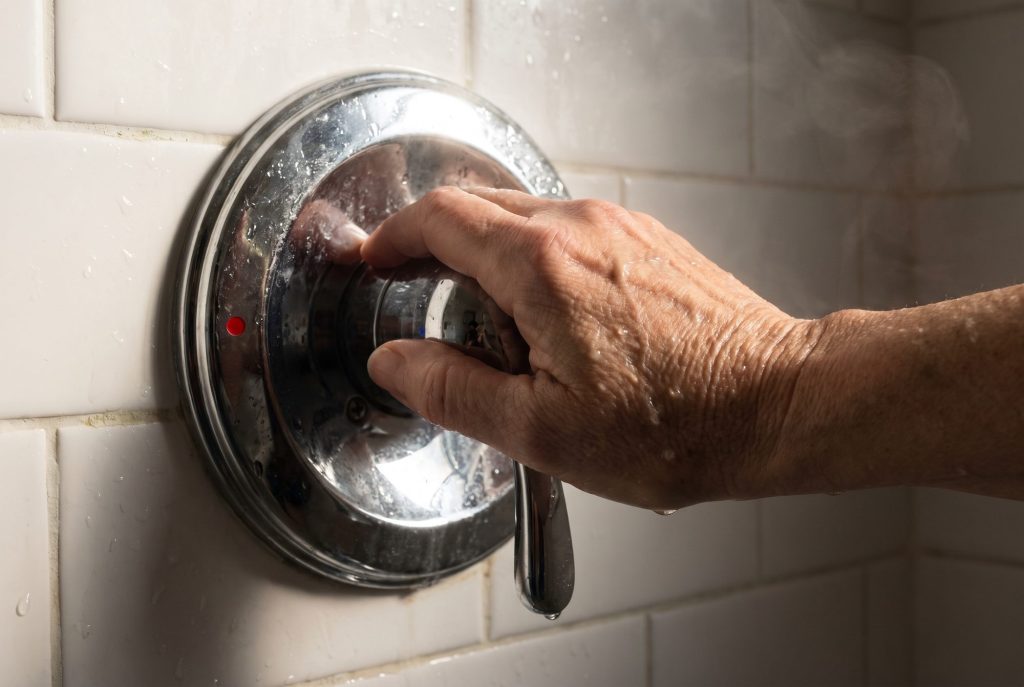
1. Water that’s too hot
This is the big one. In a study of 50 healthy volunteers, hot-water exposure more than doubled transepidermal water loss, a measure of how much water escapes through the skin, and increased redness and skin pH. The authors concluded that long, continuous water exposure damages skin barrier function, with hot water even more harmful (Herrero-Fernandez et al., 2022). An older controlled study found that warmer water made a common soap surfactant significantly more irritating, with damage rising alongside temperature (Berardesca et al., 1995).
Instead: use warm, not hot, water. Cleveland Clinic’s dermatologists say the water should be warm but not too hot (Cleveland Clinic), and the NIA and AAD give the same advice (NIA; AAD).
2. Long showers
Time matters as much as temperature. The AAD recommends limiting showers and baths to 5 to 10 minutes (AAD), and Cleveland Clinic suggests keeping them under five minutes to minimize the risk of drying out your skin (Cleveland Clinic).
Instead: save the long, steamy shower for the occasional treat. Two or three songs make a decent timer.
3. Soaping everything
Most body skin doesn’t need lather every day. According to Cleveland Clinic, the only areas you generally need to wash consistently are the face, armpits and groin (Cleveland Clinic). Shins and forearms make far less oil than the face (see why body skin ages differently), so they feel daily soap first. The NIA notes that using too much soap can make dry skin worse (NIA).
Instead: soap the areas that need it, and let the water rinse the rest.
4. Fragranced or harsh cleansers
Cleveland Clinic warns that fragrances added to soap can pull moisture from the skin and cause irritation, and suggests products labeled “gentle cleanser” or “for sensitive skin” (Cleveland Clinic). The AAD recommends fragrance-free products for dry skin, pointing out that “unscented” isn’t the same as fragrance-free, and advises avoiding deodorant soaps and products with alcohol (AAD).
Instead: a fragrance-free, gentle cleanser.
5. Scrubbing hard
Loofahs, stiff brushes and rough mitts add friction on top of hot water and soap. The AAD advises gentle exfoliation with light, circular motions, moisturizing immediately afterward, and avoiding aggressive methods on darker skin tones, where they can cause dark spots (AAD).
Instead: use your hands or a soft washcloth day to day, and keep exfoliation occasional and gentle.
6. Rubbing dry
Toweling off briskly removes more than water. Cleveland Clinic and the AAD both recommend patting skin dry rather than rubbing (Cleveland Clinic; AAD).
Instead: pat, and leave skin slightly damp.
7. Waiting to moisturize
The window right after a shower is when moisturizer works best. The AAD recommends applying it while skin is still damp (AAD), and Cleveland Clinic suggests applying emollients within three minutes of showering (Cleveland Clinic).
Instead: keep your moisturizer in the bathroom, not the bedroom.
The short list
- Hot water more than doubled water loss through the skin in one study, and it makes soap more irritating.
- Keep showers to 5 to 10 minutes, or under 5 if your skin is dry.
- Soap only the areas that need it: underarms, groin and face.
- Pat dry and moisturize within about three minutes.
Habit swaps at a glance
| Habit | Why it dries skin | Easy swap |
|---|---|---|
| Hot water | Increases water loss, redness and soap irritation | Warm water |
| Long showers | Longer water exposure weakens the barrier | 5 to 10 minutes, or under 5 |
| Lathering everywhere | Strips oil from areas that have little | Soap only underarms, groin and face |
| Fragranced or deodorant soap | Fragrance and harsh ingredients irritate | Fragrance-free gentle cleanser |
| Scrubbing | Friction on top of heat and soap | Hands or soft cloth; occasional gentle exfoliation |
| Rubbing dry | More friction | Pat dry |
| Moisturizing later | Water evaporates before it’s sealed in | Moisturize within about three minutes |
Sources: Herrero-Fernandez et al., 2022, Berardesca et al., 1995, Cleveland Clinic, AAD.
Does hard water dry out skin?
It can contribute. In a study of 80 people, skin washed with a common surfactant in hard water held significantly more surfactant residue afterward, which increased water loss through the skin and caused irritation, especially in people with eczema linked to a specific gene variant. Softening the water with an ion-exchange softener reduced those effects; chlorine had no clear effect (Danby et al., 2018). If you live in a hard-water area and your skin feels tight after every shower, rinsing thoroughly and choosing a gentle cleanser are the practical first steps.
How often should you shower?
Cleveland Clinic says once a day is the general guidance, but it varies; if you notice dryness, itch, irritation or scaling, consider skipping a day (Cleveland Clinic). After workouts, a quick rinse is still a good idea for acne-prone skin; see our guide to body acne.
A routine to prevent shower dry skin
- Warm water, 5 to 10 minutes.
- Fragrance-free cleanser on underarms, groin and any sweaty areas; water only elsewhere.
- If you shave, do it toward the end, when skin is warm and soft, as the AAD suggests (AAD).
- Pat dry, leaving skin slightly damp.
- Within three minutes, apply a cream or ointment. For textures, see body lotion, cream or oil.
- In winter, run a humidifier in the bedroom, as the AAD and NIA suggest (AAD; NIA).
The NIA also cautions against adding bath oil to the tub, since it makes the surface slippery and raises the risk of falls (NIA). Moisturize after the bath instead.
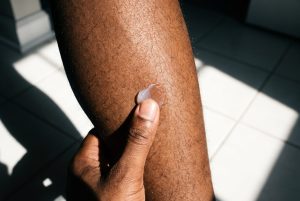
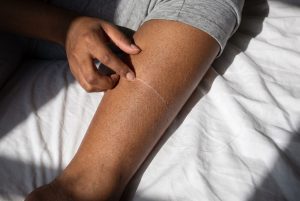
If your legs are already flaky or cracked, our guides to dry skin on legs and snakeskin legs go further.
When to see a dermatologist
Get it looked at if
- skin stays dry, itchy or scaly after two to three weeks of gentler showers and daily moisturizer
- itching keeps you awake
- you develop red, cracked patches or a rash
- your skin burns or stings after every shower, whatever products you use
The AAD advises seeing a dermatologist if dry skin doesn’t improve with home care or if you suspect a condition such as eczema or psoriasis (AAD).
Frequently asked questions
Why is my skin so dry after I shower?
Usually a combination of hot water, long showers and harsh or fragranced soap. Hot water increases water loss through the skin and makes soap more irritating (Herrero-Fernandez et al., 2022; Berardesca et al., 1995).
What water temperature is best for showering?
Warm, not hot. Cleveland Clinic, the AAD and the NIA all recommend warm rather than hot water (Cleveland Clinic; AAD; NIA).
Is it bad to shower every day?
Not necessarily. Cleveland Clinic says daily bathing is the general guidance, but suggests skipping days if your skin becomes dry, itchy or scaly (Cleveland Clinic).
Should I moisturize before or after showering?
After, while skin is still damp. Cleveland Clinic recommends applying emollients within three minutes of showering (Cleveland Clinic).
Do I need body wash on my legs?
Usually not every day. Cleveland Clinic says the areas that need consistent washing are the face, armpits and groin (Cleveland Clinic). Water alone is enough for shins on most days.
About the author
Rachel Moreno writes Body Skin Insider's guides to crepey skin, discoloration, dry skin and the ingredients that help, with a focus on the skin below the chin. Each guide lists its sources and spells out when a spot or change should be seen by a dermatologist.
How we put this together
We built this guide from 9 sources, including Cleveland Clinic, the American Academy of Dermatology and peer-reviewed studies. Key claims link to the source that supports them.
Sources
- Cleveland Clinic. “How Often Should You Shower?” Cleveland Clinic Health Essentials, 2026. health.clevelandclinic.org
- American Academy of Dermatology. “Dermatologists’ top tips for relieving dry skin.” AAD. aad.org
- Herrero-Fernandez M, Montero-Vilchez T, Diaz-Calvillo P, et al. “Impact of Water Exposure and Temperature Changes on Skin Barrier Function.” Journal of Clinical Medicine, 2022. pubmed.ncbi.nlm.nih.gov
- Berardesca E, Vignoli GP, Distante F, et al. “Effects of water temperature on surfactant-induced skin irritation.” Contact Dermatitis, 1995. pubmed.ncbi.nlm.nih.gov
- Danby SG, Brown K, Wigley AM, et al. “The Effect of Water Hardness on Surfactant Deposition after Washing and Subsequent Skin Irritation in Atopic Dermatitis Patients and Healthy Control Subjects.” Journal of Investigative Dermatology, 2018. pubmed.ncbi.nlm.nih.gov
- National Institute on Aging. “Skin Care and Aging.” NIA, National Institutes of Health. nia.nih.gov
- Cleveland Clinic. “Emollients.” Cleveland Clinic. my.clevelandclinic.org
- American Academy of Dermatology. “Hair removal: How to shave.” AAD. aad.org
- American Academy of Dermatology. “How to safely exfoliate at home.” AAD. aad.org
General information, not medical advice. For a spot that’s new, changing or bleeding, see a dermatologist.