Crepey Skin on Arms Isn’t One Problem but Two
Crinkly forearms are mostly sun damage that a retinoid and moisturizer can soften. Loose upper-arm skin is a different issue for an in-office fix.
By Rachel Moreno · Published
11 sources · Our standards
Straight answer
Crepey skin on arms is thin, finely wrinkled skin that looks like crepe paper, and the main driver is years of sun exposure breaking down the skin’s elastic fibers, with age, dryness and weight changes adding to it. Daily sunscreen on the arms, a rich moisturizer and a retinoid or lactic acid lotion can visibly soften the texture over a few months. Loose, hanging skin on the upper arms needs an in-office procedure to change much.

Cleveland Clinic names the arms as one of the two places crepey skin most often appears (the other is under the eyes), typically starting in a person’s 40s (Cleveland Clinic).
What helps depends on which part of the arm you’re looking at: the papery forearm and the soft, loose upper arm are related problems with different fixes. For background on the condition itself, see our guide to crepey skin.
Jump to
Forearms vs. upper arms: two different problems
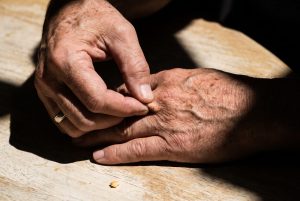
Forearms get more lifetime sun than almost any other body part, so crepey skin there often arrives with other sun-damage signs: brown spots, a thin, shiny surface, and bruises from nowhere. The upper arm is more often about laxity, skin that has stretched and lost its spring.
| Feature | Forearms | Upper arms |
|---|---|---|
| What it looks like | Fine, papery crinkling; thin, almost translucent skin; brown spots | Crinkling plus looseness or a slight hang when the arm is raised |
| Main driver | Cumulative sun exposure plus age | Age, sun, and weight loss or weight fluctuation |
| Warning signs | Easy bruising, purple patches, skin tears, white star-shaped marks | Usually cosmetic only |
| What a cream can do | Improve texture and thickness modestly over months | Improve crinkling and dryness; little effect on sagging |
| Biggest single lever | Sun protection and covering up | Procedures, if the looseness bothers you |
Why the forearms crepe first
Ultraviolet light breaks down elastin, the fibers that let skin snap back, which makes sun the leading cause of crepey skin (Cleveland Clinic). Forearms rest on car doors and hang out of short sleeves for decades. A 2018 review of chronic skin fragility in older adults lists the extensor forearms (the outer, sun-facing side), the backs of the hands and the lower legs among the classic sites of thin, nearly translucent skin (Dyer and Miller, 2018).
Why the upper arms loosen
The upper arm adds another variable: what’s underneath. Cleveland Clinic lists weight fluctuations among the causes of crepey skin (Cleveland Clinic). When fat volume shrinks after weight loss, skin that has already lost elasticity doesn’t fully retract. An industry-run clinical trial on upper arms described aging there as a mix of lost contour, firmness and elasticity together with laxity, crepiness, roughness and photodamage (Kavali et al., 2021), which is a fair summary of what people see in the mirror.
Cleveland Clinic also points to dry skin, long-term corticosteroid use, smoking, alcohol, poor sleep and stress (Cleveland Clinic). Dryness is the most fixable, and it exaggerates every fine line.
The short list
- Forearm crepiness is mostly sun damage; upper-arm crepiness adds loss of volume and laxity.
- Thin forearm skin that bruises easily or tears is a skin-fragility pattern worth mentioning to a doctor.
- Moisturizer alone makes arms look smoother within days; retinol and lactic acid need about three months.
- No cream lifts loose upper-arm skin. That takes a procedure.
When crepey forearms are a skin fragility sign
Some crepey forearms are more than a cosmetic issue. Dermatologists use the term dermatoporosis for chronic skin fragility in older adults. Its signs include thin, atrophic skin, flat purple patches that fade over one to three weeks (often called senile or solar purpura) and white, star-shaped pseudoscars (Dyer and Miller, 2018). The same review reports that the condition affected about a third of people aged 60 to 80 in one French study, and lists sun damage, long-term topical or oral corticosteroids, and blood thinners among the risk factors.
Fragile skin tears and bruises more easily, so protecting it is about safety as much as looks. If you take a blood thinner or use steroid creams on your arms, discuss it with whoever prescribes them rather than changing anything yourself.
What helps crepey skin on arms
Here’s what actually moves the needle, in rough order of payoff.
1. Sunscreen on your arms, every day
It’s unglamorous, but it’s the step that stops the damage from getting worse. The AAD recommends a broad-spectrum, water-resistant sunscreen with SPF 30 or higher on all exposed skin, reapplied every two hours and after swimming or sweating (AAD). For fragile forearms, the dermatoporosis review recommends long sleeves and avoiding the midday sun in addition to sunscreen (Dyer and Miller, 2018). A light long-sleeve layer is the cheapest anti-aging product you’ll ever own.
2. A rich moisturizer, applied to damp skin
Dry skin makes crepey arms look crepier, and moisturizer is the fastest visible fix. The AAD advises applying moisturizer within minutes of showering, choosing creams or ointments over thin lotions, and looking for ingredients such as glycerin, hyaluronic acid, lactic acid, dimethicone, petrolatum and shea butter (AAD). The AAD also calls sunscreen and moisturizer the two most effective anti-aging products you can buy (AAD). For a deeper look at formulas, see our guide to the best moisturizer ingredients for crepey skin.
3. Retinol, if your skin tolerates it
Retinol has some of the most relevant evidence for crepey arms, because the best-known study was done on arms. In a randomized, double-blind trial, 36 older adults (mean age 87) had 0.4% retinol lotion applied to one arm and a plain lotion to the other, up to three times a week for 24 weeks. The retinol side showed significantly less fine wrinkling, and biopsies showed increased collagen production and more glycosaminoglycans, molecules that hold water in the skin (Kafi et al., 2007).
Start slowly: two or three nights a week on clean, dry skin, with moisturizer on top. Irritated skin ages faster, not slower.
4. Lactic acid lotion
Lactic acid is an alpha hydroxy acid (AHA) that smooths flaky skin and draws in water. In a three-month study, twice-daily 12% lactic acid increased the firmness and thickness of both the epidermis and the deeper dermis and improved smoothness and the look of lines, while 5% lactic acid improved the surface without measurable dermal changes (Smith, 1996). The FDA notes that AHAs increase the skin’s sensitivity to the sun and advises sun protection during use and for a week after stopping (FDA). Our lactic acid lotion guide covers strengths and how to use them.
A practical split: lactic acid in the morning (then sunscreen), retinol at night on alternate days.
5. Firming body creams, with realistic expectations
There is some evidence for multi-ingredient firming moisturizers. In a 12-week, placebo-controlled, split-body trial of 40 women aged 40 to 60, a body firming moisturizer outperformed a plain moisturizer on crepiness, laxity and photodamage of the upper arms (Kavali et al., 2021). It tested one formula and was run by a contract research firm, so it doesn’t vouch for firming creams in general. The AAD’s position is blunter: firming creams plump skin temporarily, results are subtle at best, and they can’t penetrate deeply enough to lift sagging skin, although products with retinoids may help the body make more collagen (AAD).
6. In-office procedures for loose upper arms
If the issue is laxity rather than texture, procedures are where the bigger changes happen. According to the AAD, laser treatments can tighten the upper arms over three to five sessions, with results appearing two to six months after the last one, and minimally invasive radiofrequency is often used on the upper arms, with about four to five days of downtime (AAD). These treatments aren’t covered by insurance. A board-certified dermatologist can tell you whether your skin is a good candidate or whether the looseness is beyond what tightening devices can do.
A simple routine for crepey arms
- Morning: moisturizer (or a lactic acid lotion on the forearms), then broad-spectrum SPF 30+ on any skin your sleeves don’t cover.
- Midday: reapply sunscreen to the forearms if you’re outside or driving for long stretches.
- Evening shower: short and warm, gentle cleanser, pat dry.
- Within a few minutes: a thick cream on damp arms. On two or three nights a week, apply retinol first and moisturizer on top.
Expect smoother, less crinkly-looking arms within a week or two from moisturizing alone. Changes from retinol or lactic acid take months; the key retinol and lactic acid studies ran 24 weeks and three months (Kafi et al., 2007; Smith, 1996). The AAD also advises skipping products that sting or burn, since irritation can make skin look older (AAD).
Legs often crepe in parallel with arms; our article on crepey skin on legs covers the differences.
When to see a dermatologist
Get it looked at if
- your forearms bruise easily or develop purple patches without a clear bump
- your skin tears from minor knocks
- crepey skin appears suddenly or on only one arm
- you use steroid creams or take a blood thinner and your arm skin is thinning
- a spot on your arm is new, changing, bleeding or doesn’t heal
- you want to explore tightening procedures for loose upper-arm skin
Frequently asked questions
Can crepey skin on arms be reversed?
Partly. Daily moisturizer improves the look quickly, and retinol and 12% lactic acid have produced measurable increases in skin thickness and collagen-related markers in clinical studies (Kafi et al., 2007; Smith, 1996). Loose upper-arm skin won’t snap back with creams, but procedures can tighten it (AAD).
What causes crepey skin on arms at a young age?
Heavy sun exposure is the usual reason, since UV light breaks down elastin. Significant weight loss, very dry skin, smoking and long-term corticosteroid use can also contribute (Cleveland Clinic).
How long does it take to see results on crepey arms?
Moisturizer works within days. In the main studies, retinol was used for 24 weeks and 12% lactic acid for three months before the improvements were measured (Kafi et al., 2007; Smith, 1996), so plan on at least three months of consistent use.
Is crepey skin on the arms a sign of a health problem?
Usually it’s a sign of sun exposure and age. But very thin forearm skin with frequent bruising or skin tears can reflect chronic skin fragility, which is linked to long-term steroid use, blood thinners and kidney disease, among other factors (Dyer and Miller, 2018). Mention it to your doctor.
About the author
Rachel Moreno writes Body Skin Insider's guides to crepey skin, discoloration, dry skin and the ingredients that help, with a focus on the skin below the chin. Each guide lists its sources and spells out when a spot or change should be seen by a dermatologist.
How we put this together
We built this guide from 11 sources, including Cleveland Clinic, the American Academy of Dermatology and peer-reviewed studies. Key claims link to the source that supports them.
Sources
- Cleveland Clinic. “What’s Causing Your Crepey Skin and How Can You Fix It?” Cleveland Clinic Health Essentials, 2024. health.clevelandclinic.org
- Dyer JM, Miller RA. “Chronic Skin Fragility of Aging: Current Concepts in the Pathogenesis, Recognition, and Management of Dermatoporosis.” Journal of Clinical and Aesthetic Dermatology, 2018. pmc.ncbi.nlm.nih.gov
- Kafi R, Kwak HS, Schumacher WE, et al. “Improvement of naturally aged skin with vitamin A (retinol).” Archives of Dermatology, 2007. pubmed.ncbi.nlm.nih.gov
- Kavali CM, Nguyen TQ, Zahr AS, et al. “A Randomized, Double-Blind, Split-Body, Placebo-Controlled Clinical Study to Evaluate the Efficacy and Tolerability of a Topical Body Firming Moisturizer for Upper Arm Rejuvenation.” Aesthetic Surgery Journal, 2021. pubmed.ncbi.nlm.nih.gov
- Smith WP. “Epidermal and dermal effects of topical lactic acid.” Journal of the American Academy of Dermatology, 1996. pubmed.ncbi.nlm.nih.gov
- American Academy of Dermatology. “Many ways to firm sagging skin.” AAD. aad.org
- American Academy of Dermatology. “How to apply sunscreen.” AAD. aad.org
- American Academy of Dermatology. “Dermatologists’ top tips for relieving dry skin.” AAD. aad.org
- American Academy of Dermatology. “How to select anti-aging skin care products.” AAD. aad.org
- American Academy of Dermatology. “11 ways to reduce premature skin aging.” AAD. aad.org
- U.S. Food and Drug Administration. “Alpha Hydroxy Acids.” FDA. fda.gov
General information, not medical advice. For a spot that’s new, changing or bleeding, see a dermatologist.