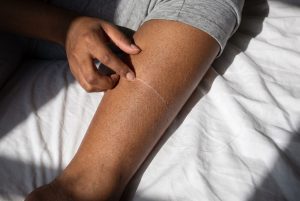
Dry Patches on Your Legs: What They Can Mean
Coin-shaped and very itchy suggests nummular eczema; a scaly ring suggests ringworm. A patch that keeps growing on a sun-exposed shin needs a doctor.
By Rachel Moreno · Published
10 sources · Our standards
Straight answer
Most dry skin patches on legs are ordinary dryness or a form of eczema, and they improve within a couple of weeks of gentler washing and a thick moisturizer. A patch that is coin-shaped and very itchy may be nummular eczema; a ring with a scaly edge suggests ringworm; thick plaques with silvery scale suggest psoriasis. A single scaly patch that keeps growing or won’t heal, especially on sun-exposed shins, should be checked by a dermatologist.
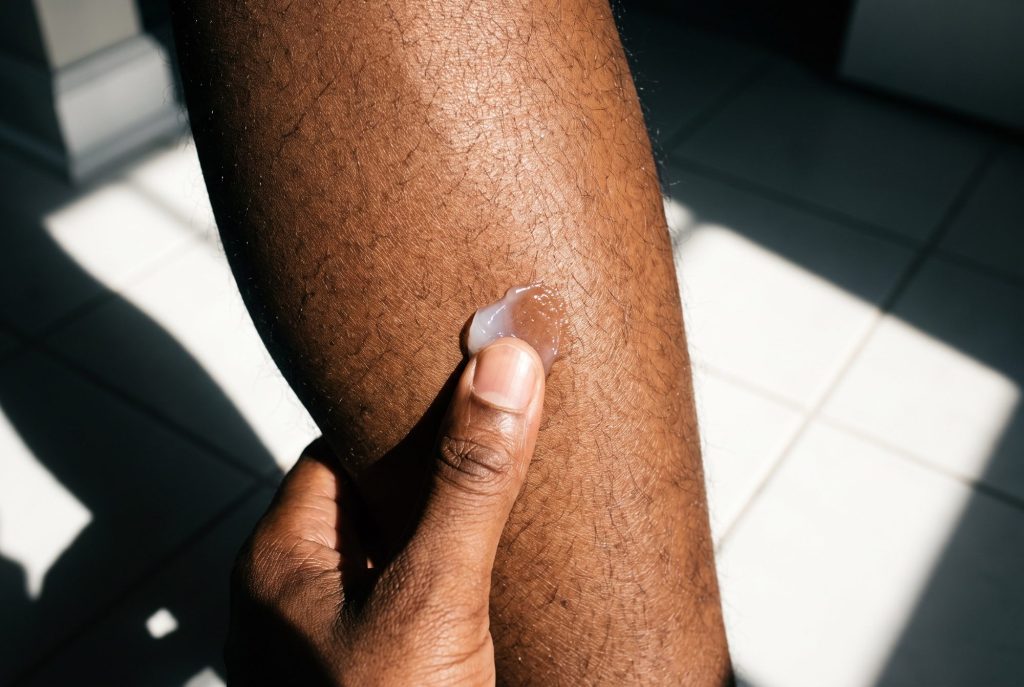
Legs are a common place for dry, rough patches: they get hot showers, shaving, tight clothing and winter air. Most patches are harmless. A few are worth a closer look, and the shape, itch level and behavior of the patch usually tell you which group it’s in.
This guide walks through the common causes. For general dryness across the legs, see our dry skin on legs guide; for the cracked, scaly pattern, see snakeskin legs.
Jump to
Common causes of dry patches on legs
Simple dry skin
The most likely explanation. Cleveland Clinic describes dry skin as rough, tight, flaking, scaling or cracked, and notes it may look lighter or darker than your normal skin tone, or red to purple (Cleveland Clinic). It tends to be patchy where friction, shaving or hot water hit hardest, and it improves quickly with the basics in the plan below.
Asteatotic eczema
When dryness on the shins cracks into a network of red lines around diamond-shaped plates, it has become eczema craquelé. DermNet describes it as most common on the shins of older people, triggered by low humidity, frequent bathing and soap (DermNet).
Nummular eczema
Coin-shaped patches are the giveaway. The AAD describes nummular eczema as starting with tiny bumps and blister-like spots that turn into coin-shaped raised patches, pink or red on lighter skin and brown or lighter than surrounding skin on darker skin tones. It’s intensely itchy, often worse at night, and commonly appears on the legs, forearms and backs of the hands. Spots can last weeks or months, and some people develop new spots as old ones clear (AAD). Yellow or golden crusts suggest infection.
Ringworm (tinea corporis)
Despite the name, ringworm is a fungal infection. The AAD describes roundish, flat patches with a raised, scaly border that tend to clear in the center, red or pink on lighter skin and brown or gray on darker skin. They itch and can slowly grow or spread (AAD). Ringworm and nummular eczema can look similar, which is a good reason to get a diagnosis rather than guess.
Psoriasis
Plaque psoriasis, which accounts for 80% to 90% of psoriasis cases, causes thick, raised patches covered with a silvery-white scale, most often on the elbows, knees, scalp and lower back (AAD). On the legs, the knees are a classic site. About half of people with plaque psoriasis develop nail changes such as tiny dents, and joint pain or swelling can signal psoriatic arthritis (AAD).
Neurodermatitis
A patch that you scratch constantly can turn thick and leathery. The AAD describes neurodermatitis (lichen simplex chronicus) as an itch-scratch cycle that turns a patch rough and discolored, red on lighter skin and violet on darker skin, eventually leathery and brownish, gray or reddish. The itch is often worse when relaxing or trying to sleep (AAD).
Stasis dermatitis
On the lower legs, dry, itchy, discolored skin over varicose veins, often with ankle swelling that improves overnight, can be stasis dermatitis, a sign of poor blood flow in the legs (AAD). Over time the skin can harden and develop sores. It needs medical care, not just moisturizer.
Diabetes-related skin changes
The AAD lists two shin-specific signs. Diabetic dermopathy causes round or oval brown or reddish-brown spots on the shins that may feel scaly at first. Necrobiosis lipoidica begins as reddish-brown spots on lighter skin or purplish spots on darker skin, then slowly expands, and the center can become waxy and thin (AAD).
Early skin cancer (Bowen disease)
This is the rare one, and the reason not to ignore a persistent patch. Bowen disease, or intraepidermal squamous cell carcinoma, is an early skin cancer confined to the top layer of skin. DermNet describes it as an irregular, scaly plaque up to several centimeters across, often orange-red but sometimes brown, most often on sun-exposed skin of the ears, face, hands and lower legs. It is usually found on sun-damaged skin, and about 5% of these lesions progress to invasive cancer (DermNet). Unlike psoriasis, it isn’t symmetrical, and moisturizer doesn’t make it go away.
The short list
- Most dry patches on legs are dryness or eczema and improve with soap-free washing and thick moisturizer.
- Coin-shaped, very itchy patches suggest nummular eczema; a scaly ring with a clearer center suggests ringworm.
- Thick, raised patches with silvery scale on the knees or elbows may be psoriasis.
- One scaly patch that keeps growing, bleeds or doesn’t heal needs a dermatologist, especially on sun-exposed shins.
Comparing dry skin patches on legs
| Possible cause | Shape and look | Itch | Other clues |
|---|---|---|---|
| Dry skin | Rough, flaky, ashy or dull areas | Mild | Worse in winter and after hot showers |
| Asteatotic eczema | Plates outlined by fine red or dark cracks, mostly on shins | Moderate | Older adults, low humidity |
| Nummular eczema | Coin-shaped, raised; pink or red, or brown on darker skin | Intense, worse at night | May ooze or crust |
| Ringworm | Ring with raised, scaly edge and clearer center | Yes | Slowly grows or spreads |
| Psoriasis | Thick, raised plaques with silvery-white scale | Variable | Knees, elbows, scalp; nail pitting |
| Neurodermatitis | Thick, leathery single patch | Intense, constant | Develops wherever you scratch habitually |
| Stasis dermatitis | Dry, discolored skin near varicose veins | Yes | Ankle swelling by evening |
| Bowen disease | Single irregular scaly plaque, orange-red or brown | Varies | Sun-exposed skin; persists despite moisturizer |
This table is a starting point for a conversation with a clinician, not a way to self-diagnose. Many of these look alike, especially on deeper skin tones.
What to do about a dry patch
For a patch that looks like ordinary dryness, give it two weeks of simple care:
- Shorten showers to 5 to 10 minutes in warm water, as the AAD recommends (AAD).
- Use a fragrance-free, gentle cleanser, and skip soap on the legs.
- Within minutes of drying off, apply a fragrance-free cream or ointment to damp skin. The AAD favors ointments and creams over lotions and lists ingredients such as glycerin, lactic acid, petrolatum, dimethicone and shea butter (AAD).
- Don’t scratch or scrub. Scratching drives the thickening in neurodermatitis and can open the skin to infection (AAD).
- If you’re unsure what the patch is, ask a clinician before reaching for anti-itch or antifungal creams, so you’re treating the right thing.
If the patch fades, it was dryness. If it doesn’t change, spreads, or looks like any of the patterns above, book an appointment. A dermatologist will examine the patch and, if needed, take a skin scraping or a small biopsy to confirm what it is.
When to see a dermatologist
Get it looked at if
- a patch doesn’t improve after two weeks of consistent moisturizing
- it is ring-shaped, spreading, or new patches keep appearing
- it oozes, crusts with yellow or golden crusts, or becomes painful
- it is a single scaly patch on sun-exposed skin that keeps growing, bleeds or won’t heal
- you have thick, silvery patches, nail pitting or joint pain
- the patch sits over varicose veins or comes with leg swelling
- you have diabetes and notice new spots on your shins
Frequently asked questions
Why do I have dry patches on my legs?
Most often because of everyday dryness from hot showers, soap, shaving and low humidity (AAD). Eczema, fungal infections and psoriasis are other common causes, and each has a typical shape and pattern.
What does eczema on the legs look like?
Nummular eczema forms coin-shaped, raised, very itchy patches, pink or red on lighter skin and brown on darker skin (AAD). Asteatotic eczema looks like cracked, crazy-paving skin on the shins (DermNet).
How can I tell if a dry patch is ringworm?
Ringworm usually forms a ring with a raised, scaly border and a clearer center, and it slowly grows (AAD). Nummular eczema can look similar, so a dermatologist’s exam is the reliable way to tell.
Can a dry patch on the leg be skin cancer?
Rarely, yes. Bowen disease, an early form of squamous cell carcinoma, appears as a persistent, scaly, often orange-red patch on sun-exposed skin, including the lower legs (DermNet). A patch that keeps growing or won’t heal should be checked.
Can dry patches on the shins be a sign of diabetes?
Sometimes. The AAD lists diabetic dermopathy, round or oval brown spots on the shins that may feel scaly at first, and necrobiosis lipoidica, slowly expanding reddish-brown or purplish patches, among skin signs of diabetes (AAD). If you notice either, mention it to your doctor.
About the author
Rachel Moreno writes Body Skin Insider's guides to crepey skin, discoloration, dry skin and the ingredients that help, with a focus on the skin below the chin. Each guide lists its sources and spells out when a spot or change should be seen by a dermatologist.
How we put this together
10 sources went into this guide, including the American Academy of Dermatology and Cleveland Clinic. Claims link straight to the source that backs them.
This guide doesn’t link to any product our publisher sells.
Sources
- American Academy of Dermatology. “Dermatologists’ top tips for relieving dry skin.” AAD. aad.org
- Cleveland Clinic. “Dry Skin.” Cleveland Clinic. my.clevelandclinic.org
- American Academy of Dermatology. “Nummular dermatitis: Signs and symptoms.” AAD. aad.org
- American Academy of Dermatology. “Ringworm: Signs and symptoms.” AAD. aad.org
- American Academy of Dermatology. “Psoriasis: Signs and symptoms.” AAD. aad.org
- American Academy of Dermatology. “Neurodermatitis: Signs and symptoms.” AAD. aad.org
- American Academy of Dermatology. “Stasis dermatitis: Signs and symptoms.” AAD. aad.org
- American Academy of Dermatology. “Diabetes: 12 warning signs that appear on your skin.” AAD. aad.org
- DermNet. “Intraepidermal squamous cell carcinoma (Bowen disease).” DermNet. dermnetnz.org
- DermNet. “Asteatotic eczema.” DermNet. dermnetnz.org
General information, not medical advice. For a spot that’s new, changing or bleeding, see a dermatologist.