Smoothing Crepey Skin on Legs Takes About Three Months
It shows first above the knees and on the shins, and it isn’t cellulite. Daily moisturizer, sunscreen and a retinoid or lactic acid do the smoothing.
By Rachel Moreno · Published
12 sources · Our standards
Straight answer
Crepey skin on legs is thin, finely crinkled skin, most noticeable above the knees, on the front of the thighs and on the shins. It comes mainly from years of sun exposure and natural aging, made more visible by dryness and weight changes. Leg skin responds well to steady care: daily moisturizer, sunscreen on bare legs and a retinoid or lactic acid lotion can noticeably improve texture within about three months.
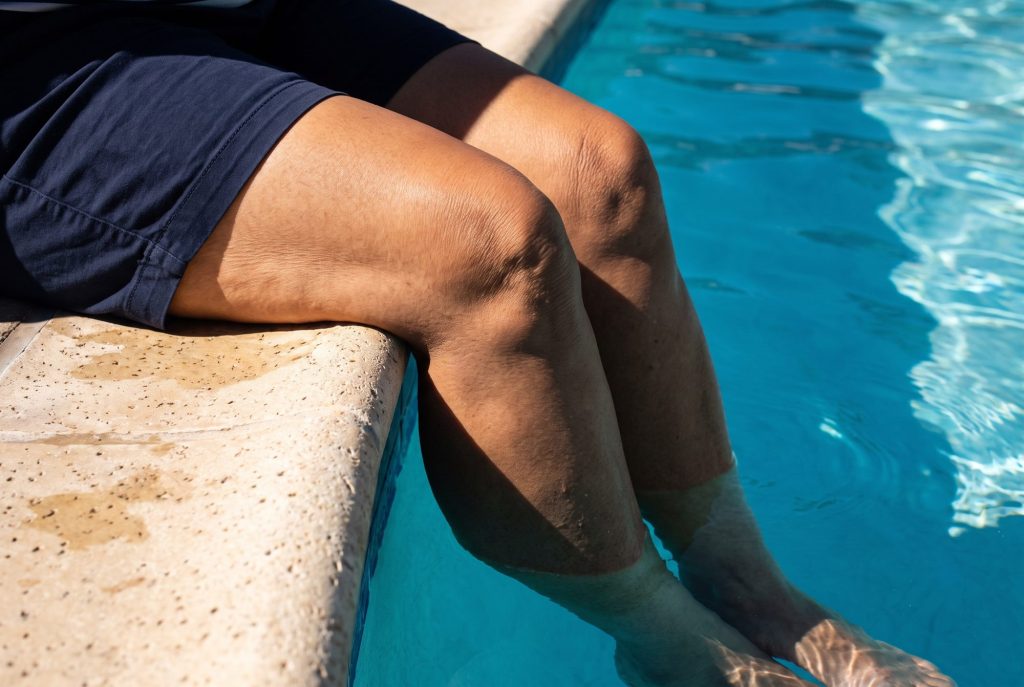
Legs are an underrated place for crepey skin, partly because people check their arms and neck in the mirror and only notice their knees in a fitting room. The good news: in at least one study comparing body sites, leg skin improved more than any other area with a simple treatment routine (Rawlings et al., 2013).
This guide covers what makes leg skin crepe, how to tell it from cellulite, and what helps. For the bigger picture, see our main guide to crepey skin.
Jump to
Where crepey skin on legs shows up
- Above the knees: the skin here folds every time you bend, so any loss of elasticity shows quickly.
- Front and inner thighs: crepiness often shows when you sit or cross your legs.
- Shins: thin and often sun-exposed, the shins tend to look shiny and finely lined, and they get dry fast.
Cleveland Clinic attributes crepey skin primarily to sun exposure, which breaks down the elastic fibers that let skin bounce back, with age, weight fluctuations, dryness, long-term corticosteroid use, smoking, alcohol, poor sleep and stress adding to it (Cleveland Clinic). Legs get more sun than most people think. The AAD specifically lists legs among the areas to cover with sunscreen, along with the neck, ears and tops of the feet (AAD).
The lower legs are also one of the classic sites of chronic skin fragility in older adults, along with the forearms and backs of the hands, according to a 2018 review (Dyer and Miller, 2018).
Crepey skin vs. cellulite: how to tell them apart
They often show up on the same thighs, but they’re different problems with different fixes.
| Feature | Crepey skin | Cellulite |
|---|---|---|
| What it looks like | Fine, crinkly lines like tissue paper; skin may feel thin | Dimples or an orange-peel or cottage-cheese texture |
| What’s going on | Damaged and thinning collagen and elastin in the skin | Tough bands under the skin pulling down while fat pushes up |
| Who gets it | Mostly people over 40, sun-exposed skin | Most women, including very fit women |
| What helps most | Sun protection, moisturizer, retinoids, lactic acid | Procedures; some creams help modestly and temporarily |
The AAD describes cellulite as fat pushing up against tough bands beneath the skin, and notes that most women have it, even very fit women (AAD). There’s one link between the two: the AAD points out that skin often thins where cellulite forms, and thicker skin may make cellulite less visible (AAD). That’s why the same retinoid habit can help both.
The short list
- Crepiness on the legs is mostly sun damage plus time, and it’s most visible above the knees.
- Cellulite is a different structure under the skin, though thin skin makes it look worse.
- Leg skin responds well to consistent care. In one study, legs improved more than the face, neck, arms or chest.
- Even a plain moisturizer used twice daily improved thigh texture in a recent trial.
What helps crepey skin on legs
Moisturize twice a day, consistently
This step is underrated because it’s boring. In a 2026 randomized, split-body trial on the lower thighs of people with mild to moderate crepiness, the active serum improved firmness, texture, crepiness and fine lines over 12 weeks. The plain base lotion used on the other leg also significantly improved texture compared with baseline (Wang et al., 2026). In other words, a good part of the visible change came from moisturizing regularly. (The trial was small, with 11 people in the thigh group, and several authors worked for the product’s manufacturer.)
The AAD recommends applying moisturizer to damp skin within minutes of showering, choosing creams or ointments over lotions, and using fragrance-free formulas (AAD). Our dry skin on legs guide covers shower habits in more detail.
Add a retinoid
Vitamin A derivatives have the most support for building thicker skin. In a 12-week controlled study, an oil-based moisturizer containing vitamin A palmitate and antioxidants improved crepey texture, dryness, scaling and roughness on the arms and lower legs, with some changes visible within two weeks. The degree of improvement ranked legs first, ahead of the arms, chest, face and neck (Rawlings et al., 2013). The authors suspected that sites with more sun damage simply had more room to improve.
The AAD notes that retinol can help thicken the skin, with results requiring six months or more of consistent use (AAD). Start two or three evenings a week on dry skin, then build up if your legs tolerate it.
Or a lactic acid lotion
Lactic acid smooths rough leg skin and holds water. In a three-month study, twice-daily 12% lactic acid increased firmness and thickness of the outer and deeper skin layers and improved smoothness and the look of lines (Smith, 1996). The FDA warns that alpha hydroxy acids such as lactic acid make skin more sensitive to sunburn, and recommends sun protection during use and for a week after stopping (FDA). Read more in our lactic acid lotion guide. Use lactic acid and a retinoid on alternate days rather than layering them.
Protect bare legs from the sun
Sun damage is the main cause, so it’s the main prevention. The AAD recommends a broad-spectrum, water-resistant SPF 30+ sunscreen on all skin not covered by clothing, about a shot glass full for the whole body, reapplied every two hours outdoors (AAD). If you want color on your legs, the AAD advises self-tanner instead of tanning beds or sunbathing (AAD).
Consider procedures for loose skin
Creams improve texture, not looseness. The AAD says ultrasound skin tightening can be used just about anywhere on the body, with modest lifting over two to six months after one treatment, and that radiofrequency can tighten skin with little or no downtime (AAD). A board-certified dermatologist can tell you whether loose skin over the knees or thighs is a realistic candidate.
When it’s not just crepey skin
Lower-leg skin that is thin and shiny can also reflect circulation problems. The AAD describes stasis dermatitis as itchy, dry, discolored skin, especially over varicose veins, often with ankle swelling that improves overnight and returns during the day. Over time, the skin can harden, darken and develop sores (AAD). That needs a medical evaluation, not a better lotion. Dark spots on the lower legs are a separate topic; see our guide to dark spots on legs.
When to see a dermatologist
Get it looked at if
- your shins or ankles swell, ache or feel heavy, especially by evening
- leg skin is discolored, hardened, or itchy over varicose veins
- you have sores on the lower legs that are slow to heal
- your skin bruises or tears from minor bumps
- skin changes appear suddenly or on only one leg
- you want to discuss tightening procedures for loose skin above the knees
Frequently asked questions
What causes crepey skin on legs?
Mainly cumulative sun exposure, which breaks down elastin, plus natural aging. Weight fluctuations, dry skin, long-term corticosteroid use and smoking can add to it (Cleveland Clinic).
Why is the skin above my knees crepey?
The skin there folds constantly, so any loss of elasticity shows quickly. Daily moisturizer and a retinoid are the most practical at-home steps; looseness above the knee may need a procedure (AAD).
Can crepey leg skin be reversed?
It can improve noticeably. In a 12-week study, leg skin showed the largest improvement of any body site with a vitamin A palmitate and antioxidant moisturizer (Rawlings et al., 2013). Expect smoother, less crinkly skin, not a complete reset.
Is crepey skin on the thighs the same as cellulite?
No. Crepey skin is a change in the skin itself, while cellulite comes from fat pushing up against bands under the skin. Thin skin can make cellulite look more obvious, which is why skin-thickening retinoids may help both (AAD).
Can weight loss make leg skin crepey?
It can contribute. Cleveland Clinic lists weight fluctuations among the causes of crepey skin (Cleveland Clinic), because skin that has lost elasticity doesn’t fully retract when the volume underneath shrinks.
About the author
Rachel Moreno writes Body Skin Insider's guides to crepey skin, discoloration, dry skin and the ingredients that help, with a focus on the skin below the chin. Each guide lists its sources and spells out when a spot or change should be seen by a dermatologist.
How we put this together
12 sources went into this guide, including Cleveland Clinic, the American Academy of Dermatology and peer-reviewed studies. Claims link straight to the source that backs them.
This guide doesn’t link to any product our publisher sells.
Sources
- Cleveland Clinic. “What’s Causing Your Crepey Skin and How Can You Fix It?” Cleveland Clinic Health Essentials, 2024. health.clevelandclinic.org
- Rawlings AV, Stephens TJ, Herndon JH, et al. “The effect of a vitamin A palmitate and antioxidant-containing oil-based moisturizer on photodamaged skin of several body sites.” Journal of Cosmetic Dermatology, 2013. pubmed.ncbi.nlm.nih.gov
- Wang JV, Makino ET, Kadoya K, et al. “Improved Skin Quality with a Novel Topical Body Serum: Distal Thighs and Back of Hands.” Journal of Cosmetic Dermatology, 2026. pubmed.ncbi.nlm.nih.gov
- Dyer JM, Miller RA. “Chronic Skin Fragility of Aging: Current Concepts in the Pathogenesis, Recognition, and Management of Dermatoporosis.” Journal of Clinical and Aesthetic Dermatology, 2018. pmc.ncbi.nlm.nih.gov
- American Academy of Dermatology. “Cellulite treatments: What really works?” AAD. aad.org
- American Academy of Dermatology. “How to apply sunscreen.” AAD. aad.org
- American Academy of Dermatology. “11 ways to reduce premature skin aging.” AAD. aad.org
- American Academy of Dermatology. “Dermatologists’ top tips for relieving dry skin.” AAD. aad.org
- Smith WP. “Epidermal and dermal effects of topical lactic acid.” Journal of the American Academy of Dermatology, 1996. pubmed.ncbi.nlm.nih.gov
- U.S. Food and Drug Administration. “Alpha Hydroxy Acids.” FDA. fda.gov
- American Academy of Dermatology. “Many ways to firm sagging skin.” AAD. aad.org
- American Academy of Dermatology. “Stasis dermatitis: Signs and symptoms.” AAD. aad.org
General information, not medical advice. For a spot that’s new, changing or bleeding, see a dermatologist.