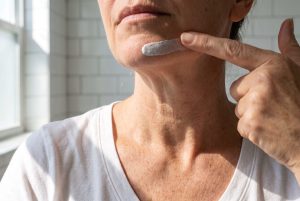
Crepey Skin and the Limits of a Good Cream
Years of sun cause most of the creasing. Retinoids and 12% lactic acid can smooth it a little over months; in-office devices go further.
By Rachel Moreno · Published
12 sources · Our standards
Straight answer
Crepey skin is skin that has thinned and lost its spring, so it folds into fine, papery creases. The biggest driver is years of sun exposure layered on top of normal aging, with dryness, large weight swings and long-term steroid use adding to it. Daily sunscreen and moisturizer keep it from getting worse, retinoids and 12% lactic acid can modestly firm and smooth it over months, and in-office devices do more, but nothing turns the clock all the way back.
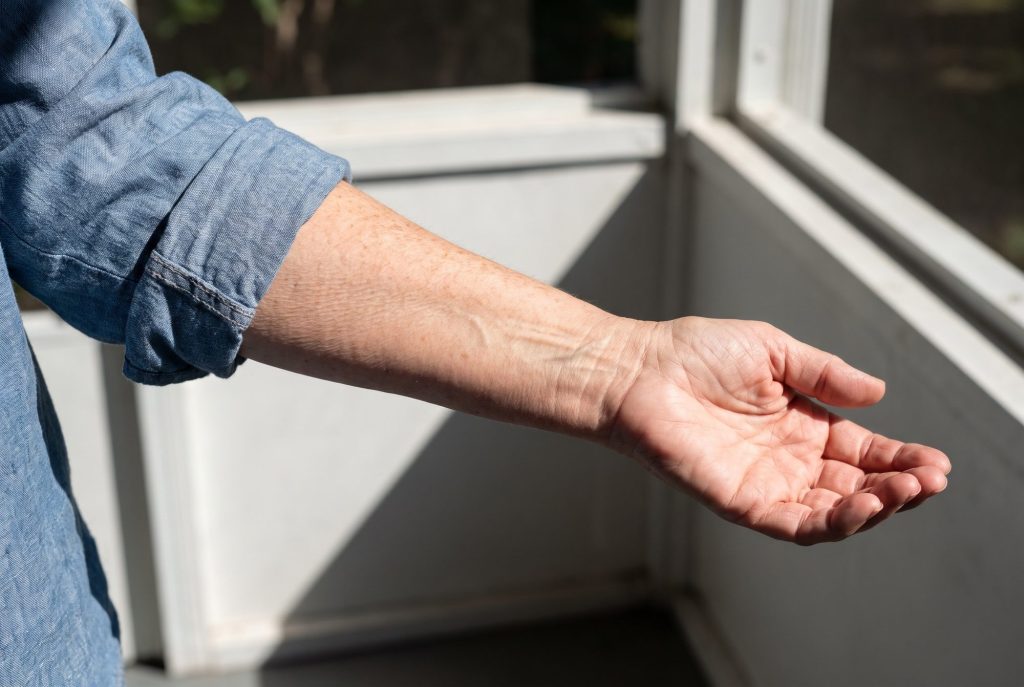
The texture tends to announce itself on the inner arms, the tops of the knees, the chest and the backs of the hands: places where skin is thin to begin with and has seen decades of daylight. Pinch it gently and it wrinkles like tissue paper instead of bunching into a soft fold. That texture is the clue to what’s going on underneath.
This guide covers what causes it, which ingredients have real data behind them (fewer than the marketing suggests), what in-office treatments can add, and when thin skin is worth showing a doctor.
Jump to
What crepey skin is
Dermatologists at Cleveland Clinic describe it as skin that becomes thin and develops fine lines, with a look like crepe paper (Cleveland Clinic). It is not a diagnosis in itself. It’s a visible sign of two things happening at once: the skin’s outer layer is thinner than it used to be, and the elastic network in the layer below has been worn down.
That second part is what separates crepiness from an ordinary expression line. A frown line forms because a muscle folds the same patch of skin thousands of times. Crepey texture forms because the skin itself has lost the elastic fibers that let it stretch and snap back, so it settles into dozens of tiny creases wherever it bends. The U.S. National Library of Medicine notes that with age the outer skin layer thins and connective tissue loses strength and elasticity, a change called elastosis that is more noticeable on sun-exposed areas (MedlinePlus).
Where it usually shows up
Cleveland Clinic names the under-eye area and the arms as common spots (Cleveland Clinic). On the body, the usual suspects are the upper and inner arms, forearms, the skin above the knees, the chest and the backs of the hands. Skin on the outer forearms, hands and lower legs is also where aging skin is most prone to becoming fragile, according to a review of chronic skin fragility in older adults (Dyer and Miller, 2018).
What causes crepey skin
There is rarely a single cause. Most people have several of these working together.
Sun exposure
Ultraviolet light breaks down elastin, the fibers that let skin stretch and return to its normal position, and Cleveland Clinic points to sun damage as the usual root of the problem (Cleveland Clinic). MedlinePlus goes further and calls sun exposure the greatest single factor in skin aging (MedlinePlus). This is why the inner arm, which sees less sun, often stays smoother than the outer forearm on the same person. Tanning beds count too: Cleveland Clinic notes that crepiness can appear as early as your 20s in people who use them regularly.
Age and hormones
Even on skin that has been carefully protected, time does some of the work. The outer layer thins, the fat layer underneath gets thinner, and oil glands produce less oil, a decline that is most pronounced in women after menopause and that makes it harder for skin to hold on to moisture (MedlinePlus). Cleveland Clinic says the texture usually starts to appear in your 40s (Cleveland Clinic).
Dryness
Dry skin doesn’t create crepiness on its own, but it exaggerates it. Dehydrated skin shows every fine line more sharply, and well-hydrated skin is better able to resist the small injuries that make the texture worse (Cleveland Clinic). This is also why a good moisturizer makes such a visible difference within minutes, and why that difference fades by the next morning.
Big weight changes
Gaining and then losing a substantial amount of weight stretches skin and then leaves it with less to cover. Cleveland Clinic lists significant weight change as one reason the texture can show up earlier than expected (Cleveland Clinic).
Long-term steroid use
Corticosteroids thin the skin. Cleveland Clinic cites long-term prednisone use as a cause, and the fragility review lists long-term use of topical and systemic corticosteroids among the main secondary risk factors for thin, easily damaged skin (Cleveland Clinic; Dyer and Miller). Never stop a prescribed steroid on your own because of how your skin looks. Raise it with the prescriber instead.
Smoking, alcohol and other habits
The American Academy of Dermatology (AAD) says smoking greatly speeds up how quickly skin ages and that alcohol dehydrates skin and damages it over time (AAD). Cleveland Clinic adds poor sleep, air pollution and stress to the list of contributors (Cleveland Clinic).
The short list
- Crepey skin is thinned skin that has lost elastic fibers, so it creases like tissue paper.
- Sun exposure is the main driver; age, dryness, weight swings, steroids, smoking and alcohol add to it.
- Sunscreen and moisturizer are the foundation. Retinoids and 12% lactic acid are the best-studied creams.
- Creams produce subtle, gradual changes. Devices such as radiofrequency and ultrasound produce more, at a higher cost.
- Thin skin that bruises or tears easily deserves a medical look, not just a new lotion.
What can improve crepey skin at home
Here’s the honest version. The AAD calls sunscreen and moisturizer the two most effective anti-aging products you can buy, and it warns that “clinically proven” on a label only means people tested the product, not that the FDA approved it (AAD). Effective products also come in every price range, so a higher price tag buys you nothing on its own. With that in mind, here’s what moves the needle.
Sunscreen: the step that stops it getting worse
No cream rebuilds elastin faster than daily UV breaks it down, so sun protection comes first. The AAD recommends a broad-spectrum, water-resistant sunscreen with SPF 30 or higher, applied about 15 minutes before going out and reapplied every two hours or right after swimming or sweating (AAD). Body coverage takes more than most people use: roughly 1 ounce, about a shot glass, to cover the skin your clothes don’t. Cleveland Clinic suggests SPF 30 at minimum and ideally SPF 50 or higher for people trying to slow crepiness (Cleveland Clinic). Sleeves and shade help on the arms, which take a beating while driving.
Moisturizer: the fast, temporary fix
Moisturizer is the only thing that changes how the skin looks the same day. Water plumps the outer layer and softens fine creases. The AAD recommends applying it to still-damp skin after bathing, notes that ointments and creams add more moisture than lotions, and lists ingredients worth looking for: jojoba oil, dimethicone, glycerin, hyaluronic acid, lactic acid, lanolin, mineral oil, petrolatum and shea butter (AAD). Keeping showers to 5 to 10 minutes in warm rather than hot water also helps. For a closer look at formulas, see our guide to the best moisturizer ingredients for crepey skin.
Retinoids: the best-studied option for aging skin
Retinoids are vitamin A derivatives, and they are the ingredient class with the strongest evidence for aging skin. The most relevant study for the body was run at the University of Michigan: 36 older adults with an average age of 87 had 0.4% retinol lotion applied to one arm and a plain lotion to the other, up to three times a week for 24 weeks (Kafi et al., 2007). The retinol arm showed significantly less fine wrinkling, and biopsies showed more glycosaminoglycans (molecules that hold water in the skin) and more new collagen. The fragility review also lists topical retinoids among treatments that improve thin, atrophic skin (Dyer and Miller).
The trade-off is irritation. Start two or three nights a week and build up slowly, and don’t stack a retinoid with several other new actives at once: the AAD notes that using more than one anti-aging product within a few days or weeks can irritate skin (AAD). Prescription-strength retinoids are a conversation for your dermatologist.
Lactic acid and ammonium lactate
Lactic acid is an alpha hydroxy acid (AHA) that does two jobs: it loosens dead surface cells and it draws water into the skin. A 1996 study in the Journal of the American Academy of Dermatology compared 5% and 12% lactic acid applied twice a day for three months (Smith, 1996). Both improved smoothness and the look of lines. Only the 12% concentration also increased firmness and thickness in the deeper dermis. The fragility review cites that same twice-daily 12% regimen as a treatment option for thin, aging skin (Dyer and Miller).
Twelve percent ammonium lactate, a related formula, has its own intriguing data. In forearm testing, it reduced the thinning caused by a potent steroid cream in both the outer and deeper skin layers (Lavker et al., 1992). We cover these products in more detail in our lactic acid lotion guide and our explainer on ammonium lactate 12%.
One catch: AHAs make skin more sensitive to the sun. In FDA research, four weeks of AHA use made volunteers 18% more sensitive to UV reddening and doubled UV-related cell damage on average, an effect that disappeared about a week after stopping (FDA). Sunscreen isn’t optional while you use them.
What creams can’t do
Labels promise firming, lifting and tightening. The AAD describes the results of skin-tightening creams and lotions as subtle at best, with effects that come mostly from moisturizing (AAD). That’s consistent with the studies above: real but modest changes that take months of consistent use. If a product claims to erase crepiness in days, the effect you’re seeing is hydration.
Treatments compared
| Option | What it does | How fast | Evidence level |
|---|---|---|---|
| Broad-spectrum SPF 30+ | Prevents further UV breakdown of elastin | Ongoing, protective | Strong (prevention) |
| Rich moisturizer on damp skin | Plumps the surface so creases look softer | Minutes; temporary | Strong for dryness, cosmetic for crepiness |
| Retinol / retinoids | Increase collagen and water-holding molecules | Months (24 weeks in the key arm study) | Good; strongest for any topical |
| 12% lactic acid | Smooths surface; may thicken epidermis and dermis | About 3 months | Moderate; small studies |
| Radiofrequency (in office) | Heats deeper tissue to stimulate collagen | Some tightening right away; best at about 6 months | Moderate; results modest |
| Ultrasound (in office) | Delivers heat deep in the skin | 2 to 6 months after one session | Moderate; modest lifting |
| Laser resurfacing | Removes damaged skin, stimulates renewal | Within about 2 weeks of healing | Most effective nonsurgical option, most downtime |
Timelines for in-office treatments come from the AAD (AAD); topical timelines come from the studies cited above.
In-office treatments
When creams have done what they can, dermatologists have devices that work deeper. According to the AAD, noninvasive options can tighten skin almost anywhere on the body, including the belly and upper arms, with less downtime and lower cost than surgery but less dramatic results (AAD).
- Ultrasound sends heat deep into the skin to prompt collagen production. Most people see modest lifting and tightening within 2 to 6 months after one treatment (AAD).
- Radiofrequency heats the tissue beneath the surface. Some tightening is felt right away, the best results appear at about 6 months, and results can last 2 to 3 years with good skin care (AAD).
- Nonablative laser usually takes 3 to 5 sessions, with results appearing gradually over 2 to 6 months (AAD).
- Laser resurfacing is the most effective nonsurgical option in the AAD’s overview, with results within about 2 weeks of healing and a recovery of 5 to 7 days (AAD).
- Dermal fillers are another option dermatologists use, alongside fractionated lasers and high-intensity focused ultrasound (Cleveland Clinic).
Ask how many sessions you’ll realistically need, what the total cost will be, and what results look like on someone with your skin tone and degree of laxity. Heat- and laser-based treatments carry a higher risk of pigment changes on deeper skin tones, which is one more reason to choose a board-certified dermatologist with experience treating skin like yours.
A realistic routine for crepey arms and legs
Korean skin care gets credit for its layering, but the useful idea for body skin is simpler: consistency, gentle handling and sun protection every day, not just at the beach. A routine you’ll actually keep beats an ambitious one you abandon in week three.
- Shower short and warm. Five to 10 minutes, a gentle fragrance-free cleanser, pat dry (AAD).
- Moisturize within minutes, while skin is still damp. Use a cream or ointment on arms, legs and chest.
- Mornings: sunscreen on every patch of skin your clothes don’t cover, including the backs of the hands and the chest.
- Evenings, alternating: a retinol body product on some nights and a lactic acid lotion on others. Start each one two or three times a week and see how your skin responds before adding the next.
- Give it three months before judging. The studies above ran 12 to 24 weeks.
Our simple weekly body care routine lays this out day by day, and if dryness is the bigger issue, start with our guide to dry skin on legs.
When to see a dermatologist
Crepey texture on its own is a cosmetic concern. Very thin skin that comes with easy bruising, purple patches or tears from minor bumps is a different matter. Doctors call that pattern dermatoporosis, a chronic fragility of aging skin. Its signs include nearly translucent skin, purple patches that take 1 to 3 weeks to fade, white star-shaped scars and skin tears after minimal trauma (Dyer and Miller). It’s linked to long-term steroid use and blood thinners, among other factors, and is worth managing with a clinician.
Get it looked at if
- your skin tears, splits or bruises after minor bumps
- you see purple patches or white, star-shaped scars on your forearms or shins
- the thinning appeared quickly or is limited to an area where you apply a steroid cream
- you take long-term oral or topical steroids or blood thinners and your skin is changing
- you want in-office treatment and need an honest assessment of what it can achieve
Frequently asked questions
Can crepey skin be reversed?
Partly. Studies of 0.4% retinol and 12% lactic acid show measurable improvement in fine wrinkling and skin thickness over 3 to 6 months (Kafi et al.; Smith), and in-office devices can add modest tightening. None of these fully restores the skin you had at 25. Prevention, mainly sun protection, keeps the gains.
At what age does crepey skin start?
Cleveland Clinic says it usually begins to show in your 40s, but it can appear in your 20s with regular tanning bed use or after large weight loss (Cleveland Clinic).
Is crepey skin the same as sagging skin?
Not quite. Crepiness is a surface texture problem from thin, inelastic skin. Sagging involves loss of support deeper down, and it often comes with weight loss or changes in the tissue under the skin. Many people have both, and in-office tightening addresses both to a degree.
Does moisturizer help crepey skin?
Yes, quickly but temporarily. Hydrated skin shows fine creases less, and creams or ointments hold more moisture than lotions (AAD). Moisturizers that also contain lactic acid or a retinoid can add a slower, longer-lasting effect.
Can losing weight cause crepey skin?
Gaining and losing a substantial amount of weight is a recognized contributor, and it can bring on crepey texture earlier than age alone would (Cleveland Clinic).
Is crepey skin a sign of a health problem?
Usually it reflects sun exposure and age. Thinning that comes with easy bruising or skin tears, or that follows long-term steroid use, should be checked by a doctor (Dyer and Miller).
About the author
Rachel Moreno writes Body Skin Insider's guides to crepey skin, discoloration, dry skin and the ingredients that help, with a focus on the skin below the chin. Each guide lists its sources and spells out when a spot or change should be seen by a dermatologist.
How we put this together
We built this guide from 12 sources, including Cleveland Clinic, MedlinePlus and peer-reviewed studies. Key claims link to the source that supports them.
Sources
- Cleveland Clinic. “Crepey Skin: Causes and Treatment.” Cleveland Clinic Health Essentials, 2024. health.clevelandclinic.org
- U.S. National Library of Medicine. “Aging changes in skin.” MedlinePlus Medical Encyclopedia. medlineplus.gov
- American Academy of Dermatology. “11 ways to reduce premature skin aging.” AAD. aad.org
- American Academy of Dermatology. “Dermatologists’ top tips for relieving dry skin.” AAD. aad.org
- American Academy of Dermatology. “How to apply sunscreen.” AAD. aad.org
- American Academy of Dermatology. “Many ways to firm sagging skin.” AAD. aad.org
- American Academy of Dermatology. “How to select anti-aging skin care products.” AAD. aad.org
- Kafi R, Kwak HS, Schumacher WE, et al. “Improvement of naturally aged skin with vitamin A (retinol).” Archives of Dermatology, 2007. pubmed.ncbi.nlm.nih.gov
- Smith WP. “Epidermal and dermal effects of topical lactic acid.” Journal of the American Academy of Dermatology, 1996. pubmed.ncbi.nlm.nih.gov
- Dyer JM, Miller RA. “Chronic Skin Fragility of Aging: Current Concepts in the Pathogenesis, Recognition, and Management of Dermatoporosis.” Journal of Clinical and Aesthetic Dermatology, 2018. pmc.ncbi.nlm.nih.gov
- Lavker RM, Kaidbey K, Leyden JJ. “Effects of topical ammonium lactate on cutaneous atrophy from a potent topical corticosteroid.” Journal of the American Academy of Dermatology, 1992. pubmed.ncbi.nlm.nih.gov
- U.S. Food and Drug Administration. “Alpha Hydroxy Acids.” FDA. fda.gov
General information, not medical advice. For a spot that’s new, changing or bleeding, see a dermatologist.