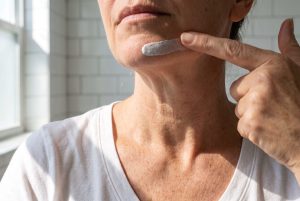
The Best Moisturizer Ingredients for Crepey Skin
Humectants pull water in, occlusives seal it, and a retinoid or 12% lactic acid changes texture over months. Most firming claims don’t hold up.
By Rachel Moreno · Published
11 sources · Our standards
Straight answer
The best moisturizer for crepey skin combines three things: humectants that pull water in (glycerin, hyaluronic acid, urea, lactic acid), occlusives that seal it (petrolatum, dimethicone, mineral oil), and, for longer-term change, a retinoid or a 12% lactic acid formula, the two ingredient types with real data on aging skin. Moisture smooths creases within minutes; firmer, thicker skin takes months.
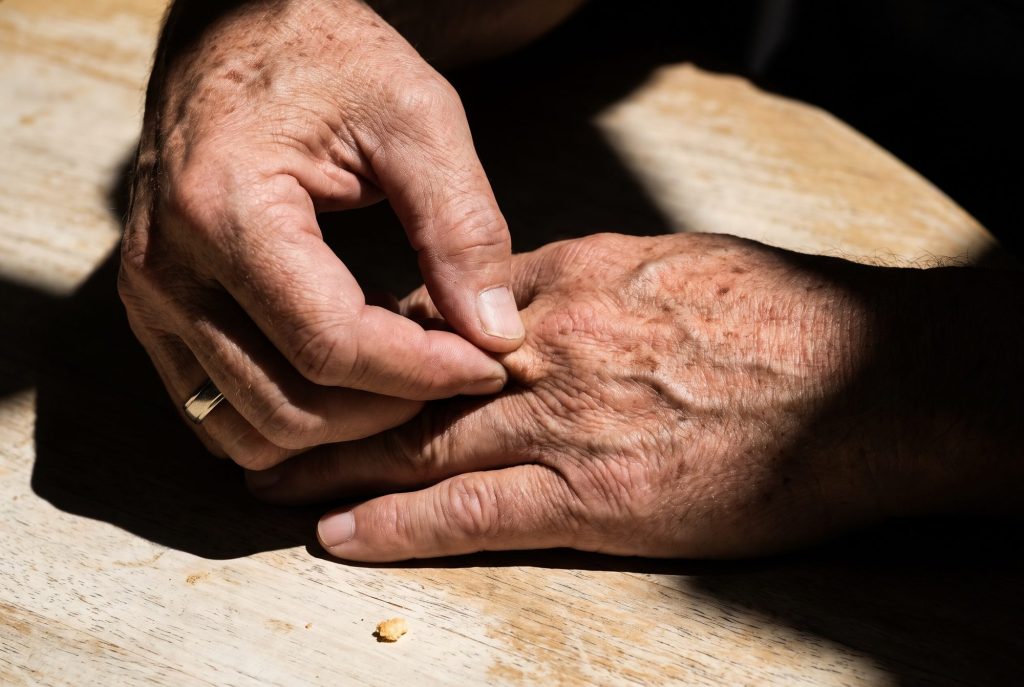
Crepey skin is thin skin that has lost elastic fibers, mainly through years of sun exposure (Cleveland Clinic). No moisturizer rebuilds elastin. What the right moisturizer for crepey skin can do is make the surface look smoother right away, keep it from drying into deeper creases, and, with a couple of specific ingredients, encourage modest structural improvement over time.
Here’s what to look for on the label, what each ingredient actually does, and what’s mostly marketing.
Jump to
What to look for in a moisturizer for crepey skin
The AAD calls sunscreen and moisturizer the two most effective anti-aging products you can buy, and notes that effective products come in every price range (AAD). For crepey body skin, a strong formula has:
- A cream or ointment texture, not a watery lotion. The AAD says ointments and creams add more moisture than lotions (AAD).
- At least one humectant to draw water into the outer layer and plump fine creases.
- At least one occlusive to stop that water from evaporating.
- One active for long-term change, either a retinoid or lactic acid, used on its own schedule.
- No fragrance, which the AAD recommends for dry skin (AAD), especially if the formula also contains acids or retinoids.
The ingredients, ranked by evidence
1. Retinoids (retinol and prescription retinoids)
Retinoids have the best evidence for aging skin of any topical ingredient. In a University of Michigan trial, 0.4% retinol lotion applied to one arm of older adults (average age 87) for 24 weeks significantly reduced fine wrinkling compared with a plain lotion on the other arm, and biopsies showed more collagen and more glycosaminoglycans, the molecules that hold water in the skin (Kafi et al., 2007). Cleveland Clinic also lists retinol creams among the treatments for crepey skin (Cleveland Clinic).
Start two or three nights a week, apply to dry skin, and buffer with a plain cream if you sting. Don’t apply it on the same night as an acid.
2. Lactic acid at 12% (including ammonium lactate)
Lactic acid smooths rough skin and holds water, and at 12% it appears to do more. In a three-month study, twice-daily 12% lactic acid increased firmness and thickness in both the outer and deeper layers of skin, while 5% changed only the surface (Smith, 1996). A review of fragile, aging skin lists that 12% regimen as a treatment option (Dyer and Miller, 2018). See our guides to lactic acid lotion and ammonium lactate 12%.
Remember the trade-off: AHAs increase sun sensitivity while you use them and for about a week afterward (FDA).
3. Urea
Urea is a humectant that also softens rough, scaly skin. In a small study of older adults with moderate to severe dryness on the arms or legs, a 10% urea cream used twice daily improved dryness and itch within one to two weeks, with no stinging reported (Lacarrubba et al., 2021). It doesn’t rebuild collagen, but very dry, crepey skin looks markedly better once it’s well hydrated.
4. Glycerin and hyaluronic acid
Both draw water into the skin and both appear on the AAD’s list of ingredients for dry skin (AAD). Cleveland Clinic recommends moisturizers with hyaluronic acid or alpha or beta hydroxy acids for crepey skin (Cleveland Clinic). Glycerin is inexpensive and found in almost every good body cream, which is a point in its favor, not against it.
5. Occlusives: petrolatum, dimethicone, mineral oil, lanolin
These seal in the water humectants pull in. All four are on the AAD’s list (AAD). On very dry, crepey shins, a thin layer of petrolatum over a humectant cream at night does more than any expensive serum.
6. Emollient butters and oils
Shea butter and jojoba oil soften skin and make a formula pleasant to use; both are on the AAD’s list (AAD). In a 12-week study, an oil-based moisturizer containing vitamin A palmitate and antioxidants improved crepey texture, dryness and roughness on the arms and lower legs compared with no treatment (Rawlings et al., 2013). The study compared the product with doing nothing, not with a plain moisturizer, so it shows that a good routine helps more than it shows that this specific formula is special.
The short list
- Look for a cream or ointment with a humectant plus an occlusive, fragrance-free.
- Retinoids and 12% lactic acid are the two ingredient types with data on thicker, firmer aging skin.
- Urea, glycerin and hyaluronic acid deliver quick smoothing through hydration.
- Studies run 12 to 24 weeks; judge a product after three months, not three days.
Ingredients compared
| Ingredient | What it does for crepey skin | How fast | Evidence |
|---|---|---|---|
| Retinol / retinoids | More collagen and water-binding molecules; fewer fine wrinkles | Months (24 weeks in arm study) | Strongest |
| Lactic acid 12% | Smooths; may thicken epidermis and dermis | About 3 months | Moderate |
| Urea | Hydrates and softens rough, scaly skin | 1 to 2 weeks | Moderate (for dryness) |
| Glycerin, hyaluronic acid | Draw water in; plump fine creases | Minutes; temporary | Strong (for dryness) |
| Petrolatum, dimethicone, mineral oil | Seal moisture in | Overnight | Strong (for dryness) |
| Shea, plant oils | Soften and smooth | Minutes; temporary | Supportive |
Sources: Kafi et al., Smith, Lacarrubba et al., AAD.
What’s mostly marketing
Products for crepey skin lean hard on words such as “firming,” “lifting” and “tightening.” The AAD describes the results of skin-tightening creams as subtle at best, with effects that come mostly from moisturizing (AAD). It also points out that “clinically proven” only means people tested the product, not that the FDA approved it (AAD).
That doesn’t mean multi-ingredient firming creams do nothing. A 2021 split-body trial of one body firming moisturizer in 40 women aged 40 to 60 found that it improved crepiness, laxity and photodamage on the upper arms more than a placebo moisturizer over 12 weeks (Kavali et al., 2021). The study was run by a contract research firm, tested a single proprietary formula, and doesn’t tell you which ingredient did the work. Peptides, collagen and plant extracts appear in many crepe-targeted creams, but the studies we found for them were small and mostly on facial skin, so treat them as extras rather than the reason to buy.
How to apply it for the best result
- Apply within minutes of showering, while skin is still damp (AAD).
- Use enough. A full arm or leg needs more than a dab; work it in until the skin no longer feels tight.
- Rotate actives at night: retinol on some evenings, lactic acid on others, plain cream on rest nights.
- Protect in the morning with a broad-spectrum SPF 30 or higher on any skin the sun will reach. Sun protection is what keeps new damage from undoing the work (Cleveland Clinic).
- Track it. Take a photo in the same light every four weeks. Changes are gradual enough that you’ll miss them otherwise.
Matching the formula to your skin
- Sensitive or easily irritated: start with a plain, fragrance-free cream with glycerin and petrolatum or dimethicone. Add one active only after a few weeks of calm skin.
- Very dry, flaky shins: a urea or lactic acid cream gives the quickest visible change, sealed with petrolatum at night.
- Sun-damaged forearms and chest: retinol is the priority, alongside daily sunscreen. Our guide to dark spots on legs covers the spots that often come with it.
- Thin skin that bruises or tears easily: keep it gentle and talk to a dermatologist before starting acids or retinoids.
For the full picture on causes and in-office options, read our guide to crepey skin, and for a day-by-day plan, see our weekly body care routine.
Frequently asked questions
What is the best moisturizer for crepey skin on arms and legs?
One that pairs a humectant such as glycerin, urea or hyaluronic acid with an occlusive such as petrolatum or dimethicone, in a cream or ointment texture (AAD). For longer-term improvement, add a retinol or 12% lactic acid product on alternate nights (Kafi et al.; Smith).
Can a moisturizer get rid of crepey skin?
Not completely. Moisturizer makes crepey skin look smoother within minutes, and certain actives modestly improve firmness over months, but creams can’t restore lost elastin. In-office treatments go further (AAD).
Is retinol or lactic acid better for crepey skin?
Retinol has the stronger evidence on aging skin (Kafi et al.); 12% lactic acid adds exfoliation and hydration and has shown thickening effects too (Smith). Many people use both, on different nights.
Does hyaluronic acid help crepey skin?
It helps the way any good humectant does: by drawing water into the surface so fine creases look softer (Cleveland Clinic). The effect is real but temporary, so use it daily and seal it in.
How long until I see results?
Hydration shows the same day. Structural changes took 12 weeks in the lactic acid and body-moisturizer studies and 24 weeks in the retinol study (Smith; Kafi et al.).
About the author
Rachel Moreno writes Body Skin Insider's guides to crepey skin, discoloration, dry skin and the ingredients that help, with a focus on the skin below the chin. Each guide lists its sources and spells out when a spot or change should be seen by a dermatologist.
How we put this together
11 sources went into this guide, including the American Academy of Dermatology, Cleveland Clinic and peer-reviewed studies. Claims link straight to the source that backs them.
This guide doesn’t link to any product our publisher sells.
Sources
- American Academy of Dermatology. “Dermatologists’ top tips for relieving dry skin.” AAD. aad.org
- Cleveland Clinic. “Crepey Skin: Causes and Treatment.” Cleveland Clinic Health Essentials, 2024. health.clevelandclinic.org
- American Academy of Dermatology. “How to select anti-aging skin care products.” AAD. aad.org
- American Academy of Dermatology. “Many ways to firm sagging skin.” AAD. aad.org
- Kafi R, Kwak HS, Schumacher WE, et al. “Improvement of naturally aged skin with vitamin A (retinol).” Archives of Dermatology, 2007. pubmed.ncbi.nlm.nih.gov
- Smith WP. “Epidermal and dermal effects of topical lactic acid.” Journal of the American Academy of Dermatology, 1996. pubmed.ncbi.nlm.nih.gov
- Dyer JM, Miller RA. “Chronic Skin Fragility of Aging: Current Concepts in the Pathogenesis, Recognition, and Management of Dermatoporosis.” Journal of Clinical and Aesthetic Dermatology, 2018. pmc.ncbi.nlm.nih.gov
- Lacarrubba F, Verzì AE, Dinotta F, Micali G. “10% urea cream in senile xerosis: Clinical and instrumental evaluation.” Journal of Cosmetic Dermatology, 2021. pubmed.ncbi.nlm.nih.gov
- Rawlings AV, Stephens TJ, Herndon JH, et al. “The effect of a vitamin A palmitate and antioxidant-containing oil-based moisturizer on photodamaged skin of several body sites.” Journal of Cosmetic Dermatology, 2013. pubmed.ncbi.nlm.nih.gov
- Kavali CM, Nguyen TQ, Zahr AS, et al. “A Randomized, Double-Blind, Split-Body, Placebo-Controlled Clinical Study to Evaluate the Efficacy and Tolerability of a Topical Body Firming Moisturizer for Upper Arm Rejuvenation.” Aesthetic Surgery Journal, 2021. pubmed.ncbi.nlm.nih.gov
- U.S. Food and Drug Administration. “Alpha Hydroxy Acids.” FDA. fda.gov
General information, not medical advice. For a spot that’s new, changing or bleeding, see a dermatologist.