The Crepey Neck Routine That Doesn’t Stop at Your Jaw
Sunscreen down to the collarbones every morning, a retinoid or vitamin C at night, for at least three months. Neck bands need a procedure instead.
By Rachel Moreno · Published
11 sources · Our standards
Straight answer
A crepey neck is thin, finely crinkled skin on the front and sides of the neck, caused mainly by years of sun exposure and the natural loss of elasticity with age. The daily care that helps is simple: sunscreen down to the collarbones every morning, a moisturizer, and a retinoid or vitamin C product used consistently for at least three months. Loose skin and muscle bands under the jaw are a different problem that creams can’t fix.
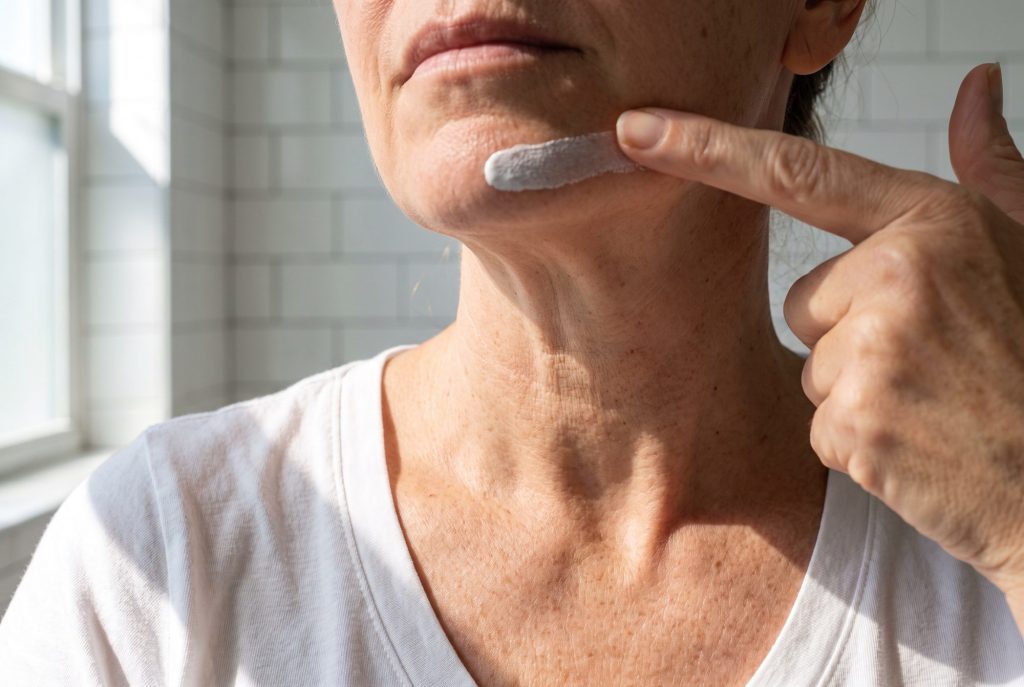
The neck tends to get skipped. Face routines stop at the jawline, sunscreen often stops there too, and years later the neck looks older than the face above it. Cleveland Clinic names sun exposure as the main cause of crepey skin, because UV light breaks down elastin, the fibers that let skin spring back (Cleveland Clinic).
This guide is about the skin itself: the fine, crinkly texture. If you’re dealing with sagging, banding or fullness under the chin, that’s what doctors often call “turkey neck,” and we’ll cover where the line between the two falls. For crepey skin elsewhere on the body, see our main guide.
Jump to
Crepey neck vs. sagging neck
These two often appear together, but they live in different layers.
| Feature | Crepey neck | Sagging or “turkey” neck |
|---|---|---|
| What you see | Fine, crisscrossing lines and thin, papery texture | Loose folds, vertical bands, or fullness under the chin |
| Where the problem is | The skin: damaged collagen and elastin | Skin, fat and the platysma muscle, alone or combined |
| Main causes | Sun exposure, age, dryness | Aging, weight gain, genetics, weakened neck muscles |
| What creams can do | Improve texture and fine lines over months | Very little |
| What helps more | Daily sunscreen, retinoids, vitamin C; lasers for stubborn cases | Injections, energy-based tightening or a neck lift |
Cleveland Clinic describes “turkey neck” as a problem with the neck’s skin, fat or underlying muscle, or a mix of the three, driven by aging, weight gain, genetics, sun damage, smoking and weakened platysma muscles (Cleveland Clinic).
Neck discoloration that comes with crepiness
On fair skin, long-term sun can also leave reddish-brown, slightly thin patches on the sides of the neck, with the shaded area under the chin spared. DermNet calls this poikiloderma of Civatte and notes it’s most common in middle-aged and older fair-skinned people, especially postmenopausal women with significant sun exposure (DermNet). Sun and photosensitizing cosmetics, particularly fragrances, are among the contributing factors. That’s a good reason to spray perfume on clothing rather than on the sides of your neck.
The short list
- Neck crepiness is mainly a sun-damage problem, and the neck is one of the most commonly skipped areas for sunscreen.
- Creams can improve fine lines and texture. They can’t tighten muscle bands or remove fat under the chin.
- The neck tends to respond more slowly than other body areas, so give any routine at least three months.
- Keep perfume off the sides of the neck if you’re prone to sun-related discoloration.
Morning care: protect
Sunscreen to the collarbones
This is the single most effective habit. The AAD names the neck among the areas people commonly miss and recommends a broad-spectrum, water-resistant sunscreen with SPF 30 or higher, reapplied every two hours when you’re outdoors (AAD). Bring your face sunscreen down over the front and sides of the neck and onto the upper chest. The AAD calls sunscreen and moisturizer the two most effective anti-aging products you can buy (AAD).
Vitamin C under sunscreen
Vitamin C is one of the few antioxidants with a neck-relevant trial. In a six-month, double-blind study of women with sun-damaged skin on the lower neck and arms, a 5% vitamin C cream improved overall scores compared with the base cream, increased the density of fine skin surface texture, reduced deep furrows, and showed signs of elastic tissue repair under the microscope (Humbert et al., 2003). Apply it after cleansing, before moisturizer and sunscreen.
Moisturizer
A moisturizer won’t rebuild collagen, but hydrated skin shows fine lines less. Use whatever you use on your face, or a body cream if it doesn’t irritate.
Evening care: repair
A retinoid, introduced slowly
Retinoids are the backbone of most evidence-based neck routines. On aged arm skin, 0.4% retinol applied up to three times a week for 24 weeks reduced fine wrinkling and increased collagen production compared with a plain lotion (Kafi et al., 2007). Neck-specific data come mostly from formulated products: a multi-ingredient neck treatment containing retinol, a tripeptide and glaucine significantly improved fine lines, crepiness, laxity and texture after 12 to 16 weeks in clinical trials (Sullivan et al., 2023). Those trials tested one commercial formula, so treat them as evidence that retinol-based neck care can work, not as an endorsement of a product.
Start with two or three evenings a week, applied to dry skin, and add moisturizer on top. Stop and scale back if your neck stings or peels; the AAD advises dropping products that sting or burn, since irritation can make skin look older (AAD).
Be patient with the neck
In a study comparing body sites, an oil-based vitamin A and antioxidant moisturizer improved crepiness and other signs of sun damage across the face, neck, chest, arms and legs over 12 weeks. The size of the improvement ranked legs, arms, chest, face, and then neck last (Rawlings et al., 2013). Translation: the neck responds, but it’s often the slowest area to show it.
A simple daily routine
| Step | Morning | Evening |
|---|---|---|
| 1 | Gentle cleanse or rinse | Gentle cleanse |
| 2 | Vitamin C serum on face, neck and upper chest | Retinoid two to three nights a week (build up slowly) |
| 3 | Moisturizer | Moisturizer |
| 4 | Broad-spectrum SPF 30+ down to the collarbones | Nothing else needed |
The AAD suggests mastering the basics for a few weeks before adding products aimed at a single concern, and setting realistic expectations, since a cream won’t give you the results of a surgical lift (AAD).
When procedures make more sense
If texture improves but looseness remains, the next steps are in-office. According to the AAD, ultrasound tightening can produce modest lifting two to six months after one session with little downtime, and minimally invasive radiofrequency is often used on the neck, with results building for up to a year (AAD). Cleveland Clinic lists other options for an aging neck, including laser resurfacing, microneedling, radiofrequency microneedling, injections that dissolve fat under the chin, neuromodulator injections for muscle bands, and, for significant laxity, a neck lift (Cleveland Clinic).
For reddish-brown sun discoloration on the sides of the neck, DermNet reports that pulsed dye laser and intense pulsed light are considered the best approaches, though results vary and the condition is chronic (DermNet).
A board-certified dermatologist can tell you which layer is driving what you see, which saves money on the wrong fix.
When to see a dermatologist
Get it looked at if
- a spot or patch on your neck is new, changing, scaly, bleeding or won’t heal
- neck discoloration is spreading, itchy or has an unusual shape
- your neck reacts to every product with redness or stinging
- you notice sudden thinning or loosening of neck skin
- you want an honest opinion on whether tightening procedures will help
Frequently asked questions
What causes a crepey neck?
Mostly cumulative sun exposure, which breaks down the elastin that keeps skin springy, plus natural aging. Dryness, weight changes, smoking and long-term corticosteroid use can add to it (Cleveland Clinic).
Can a crepey neck be reversed?
It can be improved, not erased. Retinoids and vitamin C have produced measurable gains in fine lines and skin texture over three to six months in clinical studies (Sullivan et al., 2023; Humbert et al., 2003). Laxity and muscle bands usually need procedures.
Do neck creams work?
Some formulas with retinol and other actives have shown real improvements in crepiness and texture over 12 to 16 weeks (Sullivan et al., 2023). A dedicated neck cream isn’t required, though. The active ingredient matters more than the label.
Can I use my face retinol on my neck?
Generally yes, if you start slowly. Begin two or three nights a week and stop if the skin stings or peels, since the AAD advises against continuing products that irritate (AAD).
At what age does neck skin start to crepe?
Cleveland Clinic says crepey skin typically starts to appear in people’s 40s (Cleveland Clinic). How early depends largely on how much sun the neck has seen.
About the author
Rachel Moreno writes Body Skin Insider's guides to crepey skin, discoloration, dry skin and the ingredients that help, with a focus on the skin below the chin. Each guide lists its sources and spells out when a spot or change should be seen by a dermatologist.
How we put this together
11 sources went into this guide, including Cleveland Clinic, DermNet and peer-reviewed studies. Claims link straight to the source that backs them.
This guide doesn’t link to any product our publisher sells.
Sources
- Cleveland Clinic. “What’s Causing Your Crepey Skin and How Can You Fix It?” Cleveland Clinic Health Essentials, 2024. health.clevelandclinic.org
- Cleveland Clinic. “14 Ways to Get Rid of Your Turkey Neck.” Cleveland Clinic Health Essentials, 2023. health.clevelandclinic.org
- Rawlings AV, Stephens TJ, Herndon JH, et al. “The effect of a vitamin A palmitate and antioxidant-containing oil-based moisturizer on photodamaged skin of several body sites.” Journal of Cosmetic Dermatology, 2013. pubmed.ncbi.nlm.nih.gov
- Sullivan K, Law RM, Lain E, et al. “Evaluation of a retinol containing topical treatment to improve signs of neck aging.” Journal of Cosmetic Dermatology, 2023. pubmed.ncbi.nlm.nih.gov
- Humbert PG, Haftek M, Creidi P, et al. “Topical ascorbic acid on photoaged skin. Clinical, topographical and ultrastructural evaluation: double-blind study vs. placebo.” Experimental Dermatology, 2003. pubmed.ncbi.nlm.nih.gov
- DermNet. “Poikiloderma of Civatte.” DermNet. dermnetnz.org
- American Academy of Dermatology. “How to apply sunscreen.” AAD. aad.org
- American Academy of Dermatology. “Many ways to firm sagging skin.” AAD. aad.org
- American Academy of Dermatology. “How to select anti-aging skin care products.” AAD. aad.org
- American Academy of Dermatology. “11 ways to reduce premature skin aging.” AAD. aad.org
- Kafi R, Kwak HS, Schumacher WE, et al. “Improvement of naturally aged skin with vitamin A (retinol).” Archives of Dermatology, 2007. pubmed.ncbi.nlm.nih.gov
General information, not medical advice. For a spot that’s new, changing or bleeding, see a dermatologist.